

AI and search are the new gatekeepers, not in a doom sense, just in the quiet way most routes to opportunity now begin: a query box, a recommender, a shortlist. If your identity is prose while theirs is code, you’re asking a metal detector to find a book.
Most professionals have depth that never becomes signal. The fix isn’t louder self‑promotion; it’s clearer structure.
Machine‑readable professional identity
A machine‑readable professional identity is a structured profile of your work, roles, skills, projects, and outcomes, organized as discrete, labeled elements. It turns narrative accomplishments into consistent claim‑evidence pairs and tags so AI, search engines, and platforms can parse, rank, and match your expertise without guessing.
See the new gate
I used to treat my bio like a story for conference organizers. It read well, but search treated it like fog: interesting atmosphere, no landmarks. The moment I searched my own name plus a target skill and saw unrelated results outrank me, I understood the gate had moved.
The real problem isn’t visibility; it’s legibility. If your value is implicit, buried in long paragraphs or scattered posts, machines can’t map it. Think of your online presence like a skyline: distinct, labeled buildings are easier to spot than a single sprawling warehouse.
Name the real cost
The cost of sticking with unstructured identity is quiet attrition. You miss shortlists you never know existed. You get slotted into generic roles because your signals collapse to titles and buzzwords. Peers who could vouch for you don’t have the right handles to describe you.
A quick check: search your name with three terms you want to be found for. If the results don’t consistently return your profile and an artifact proving you’ve done work in that lane, you have a weak public signal. That weakness compounds over time, like interest working against you.
Learn what machines read
The turning point for me was realizing machines don’t read intent; they read structure. A convincing story for a human still looks like a brick of text to a parser. The fix wasn’t more adjectives, it was discrete, labeled fields that said the same thing in fewer, clearer pieces.
Here’s the translation shift in plain terms: Story becomes “Led strategic overhaul of data operations to improve analytics culture.” Structured signal becomes Category = Data Operations Leadership; Mechanism = Built a metrics taxonomy and ownership model; Outcome = Reduced time‑to‑insight from weeks to days.
Build the signal spine
I tried small fixes first: tinkering with headlines, sprinkling keywords. It felt like seasoning soup without tasting it. What finally worked was committing to a three‑part spine and letting everything hang from it like a sturdy coat rack.
The spine has three parts: Category (the lane a peer would place you in), Mechanism (what you do repeatedly that others don’t), and Outcome (the change you produce).
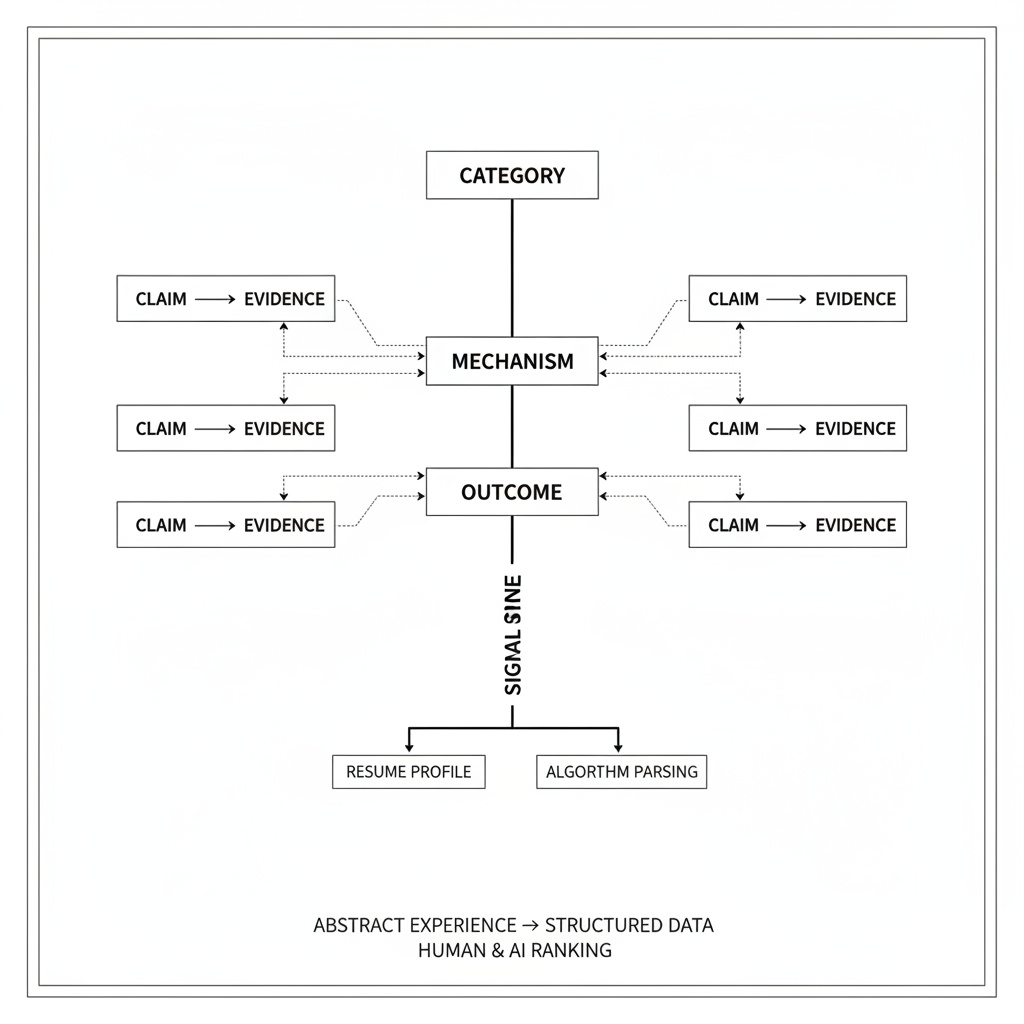
Two examples illustrate this structure. A security lead might frame their work as Category = Application Security; Mechanism = Threat modeling integrated into design reviews; Outcome = Fewer critical findings post‑release. A RevOps manager could position themselves as Category = Revenue Operations; Mechanism = Unified stage definitions and pipeline hygiene; Outcome = Tighter forecast variance.
Show proof without hype
Proof is the antidote to performance. Instead of big claims, use compact claim‑evidence pairs, five is a good start on a single page. Each pair should read like a small contract: what you assert, and the artifact that backs it.
Claim: “I design metrics that drive real decisions.” Evidence: a public talk deck, a redacted KPI doc, or a case write‑up summarizing the before/after choices. Claim: “I stabilize teams under pressure.” Evidence: incident postmortems with your role labeled and the decision timeline.
A founder hired me after investors kept mislabeling her as “ops‑heavy.” We rephrased her lane to Category = B2B Product Strategy, Mechanism = Customer‑informed prioritization via quarterly decision councils, Outcome = Faster alignment on roadmap trade‑offs. We attached two artifacts: a sanitized council agenda and a one‑page “decision memo” template with her annotations. The next three intros she received referenced those exact assets. No hype, just handles people could grab.
Make AI and personal branding legible
This step felt awkward at first, like speaking in short sentences after a life of essays. But brevity with labels isn’t robotic, it’s respectful to both readers and machines.
Refactor your headline using “Category + Mechanism → Outcome.” Example: “Data Operations Leader → Build taxonomy + ownership to cut analysis drift.” Rewrite your About as components: 2–3 lanes you operate in, 3–5 decision patterns you trust, and a short list of outcomes you produce consistently. Map each item to one proof artifact.
Fill your experience with repeatable patterns. For each role, list three claim‑evidence pairs. Keep verbs concrete: “built, ” “retired, ” “stabilized, ” “translated, ” “negotiated.” Publish one evidence artifact per month: a sanitized teardown, a short decision memo, or a postmortem reflection. Consistency outranks volume.
If you’re unsure how to phrase the spine, borrow prompts from your own work: What do peers page you for? What decisions do leaders delegate to you without flinching? What failure patterns do you prevent?
Translate for LinkedIn without theater
LinkedIn is your primary authority surface. Treat it like a structured brief, not a billboard. One metaphor helps: think index, not brochure.
Headline: lead with Category, then Mechanism. Avoid vague slogans. About: write in labeled blocks, “Lanes, ” “How I work, ” “Outcomes, ” “Selected proof.” Experience: convert bullets into claim‑evidence pairs. Link to artifacts where possible or name them clearly (“Deck: Metrics Taxonomy, ” “Post: Incident Review Pattern”).
For resumes and ATS, mirror the same structure without stuffing. Use consistent titles, standardized skill tags, and the same claim‑evidence pairs. If a platform asks for fields, fill them; fields are how machines avoid guessing.
A quality test you can trust
Before you ship, run a peer test. Send one page with your spine and five claim‑evidence pairs to a smart colleague and ask two questions: If you had to introduce me in two sentences, what would you say? What roles or problems am I obviously the answer for?
If their answers match your intent within a word or two, you’re coherent. If not, reduce adjectives, tighten verbs, and move artifacts closer to claims. Clarity beats charisma. When in doubt, slow down, observe how you actually make decisions, and name those patterns.
When machines sort by structure, substance becomes a visibility moat. This isn’t about gaming algorithms; it’s about telling the truth in a way both humans and machines can rank.
Your identity online should read like a well‑labeled workshop: tools on the wall, projects on the bench, instructions under each station. Start with a spine (Category, Mechanism, Outcome). Attach five proofs. Translate once for LinkedIn and your resume. Then keep adding quiet, sturdy artifacts. Make your professional identity readable by the future.