

Corporate careers are shifting from role-based evaluation to signal-based recognition. The professionals who advance beyond their titles make their thinking legible, converting latent expertise into clear public positions that attract the right opportunities.
A quiet change is underway. Opportunities increasingly find the people who signal clarity, not just the ones with long histories. If your work is strong but your public signal is faint, you’re competing as a commodity. The lens here is simple: convert latent professional value into explicit authority signals. That’s the move from job seeker to thought asset.
Name the real problem
In most orgs, your story lives in meeting rooms, slide decks, and people’s memory. That’s a weak public signal. Resumes record tasks; they rarely show how you think, when your judgment mattered, or what principles guide your decisions.
Most professionals have depth that never becomes signal. The market now rewards clarity of position, not just tenure.
A thought asset is a professional recognized for coherent insights, proof-backed claims, and a defensible narrative. Instead of being evaluated only by titles, they’re known by a clear position, visible decision patterns, and public artifacts that show judgment. This creates career pull across roles and companies.
Trace the evolution
I’ve watched good people cap out because their expertise stayed private. The ones who advanced beyond their title made their thinking legible. The progression moves through distinct stages: Worker executes scope with reliability. Specialist owns depth in a narrow lane. Authority is sought for judgment, not just output. Signal node broadcasts a coherent position that attracts the right problems.
Consider a finance manager who reconciles variance, that’s Worker level. When they repeatedly diagnose root causes across business lines, they become a Specialist. When peers ask them to weigh trade-offs before quarter close, they’re an Authority. When they publish a simple lens for “cash clarity in complex orgs, ” they become a Signal node.
Build a narrative spine
A strong position has three parts, category, mechanism, and outcome. Category defines the arena you stand in, like “B2B retention economics.” Mechanism explains how you consistently create outcomes through your decision patterns and practical lens. Outcome specifies the repeatable end state you help produce.
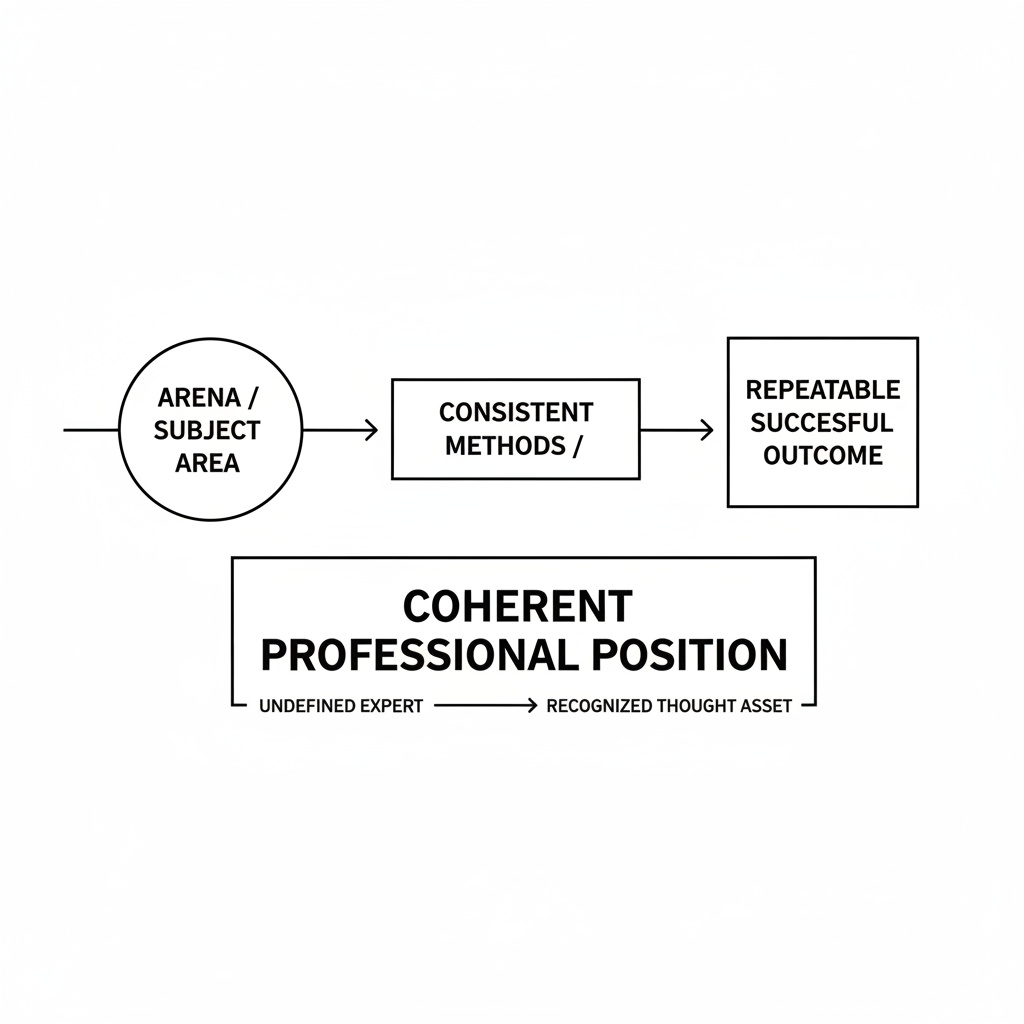
Here’s how it works in practice: “Category: supply chain risk. Mechanism: constraint-mapping with decision gates before procurement commits. Outcome: fewer surprise stockouts and measured cash stability.” That single sentence is a coherent positioning others can test.
To build yours, pull from your expertise map. What problems recur? What choices did you make under pressure? What would you do again? These patterns become your positioning foundation.
Show proof without theater
People don’t need slogans; they need evidence of judgment under constraints. Publish small, concrete authority artifacts that a smart peer can inspect. A one-page teardown of a decision you owned works well, including trade-offs you rejected and why. A short “before/after” where your mechanism prevented a predictable failure demonstrates value. A pattern note showing three signals you watch to call timing early reveals your decision framework.
You don’t need to perform; you need to translate. Treat “brand” as coherent positioning plus public signal.
I once worked with a director whose calendar was full but whose public signal was thin. We pulled three internal post-mortems, anonymized them, and distilled the pattern: “de-risk complex rollouts by sequencing dependency-heavy steps earlier.” One week later, their LinkedIn carried a clear spine, no hype, just proof.
A security lead who publishes a two-paragraph incident reconstruction with the call they made at minute 12 and the criterion they used shows judgment on display. That’s the kind of artifact that travels.
Use personal branding as quiet power
The process starts with extracting judgment from your experience. List five decisions you made under real constraints, noting what you saw early, what you ruled out, and the principle behind it. Build your stance line in one sentence using the category-mechanism-outcome format, keeping it boring and testable.
Publish authority artifacts on a cadence you can sustain, one artifact every two weeks creates momentum without strain. Tune LinkedIn as your authority surface with your headline as stance line, about section as proof-backed claims, and features as artifacts. Write for a peer who needs to recognize you in 10 seconds.
If you’re pivoting careers, bridge truthfully by naming the adjacent category and the overlap in decision patterns. “I’m moving from consumer growth to B2B retention. My through-line is customer lifetime value discipline. I use cohort health gates before spend. Outcome: reliable revenue quality.” That’s alignment in one breath.
Run a defensibility test
Before you publish, ask: could a smart peer argue against this? Good. Now add the constraint you operated under, the alternative you declined, and the negative space, what you don’t claim. If the story holds with those edges, you have a defensible narrative.
Three quick checks ensure your positioning works: Clarity means a peer can restate your stance line without you in the room. Credibility requires each claim to map to a public artifact or named decision. Consistency demands your artifacts repeat the same through-line, not random topics.
The shift from employee to thought asset isn’t about louder messaging. It’s about making your real judgment legible and portable, positioning yourself as a strategic asset rather than just a role holder.