
Your resume records what you did. Your online presence signals what you’re ready to do next. In most searches, recruiters check LinkedIn and Google first, then decide whether to reach out.
Your “digital resume” works 24/7, either for you or against you. It’s the live combination of your LinkedIn profile, personal site or portfolio, public activity, and Google results. Recruiters use it to confirm skills, judge fit, and check for risks before outreach. Since it works around the clock, clarity, consistency, and proof matter more than length.
The reality is straightforward: treat LinkedIn as your primary, searchable portfolio and keep it active, not static. Lead with proof-backed outcomes, clean search results, and consistent messaging across platforms. Stay authentic, use AI for drafts, but let your voice, judgment, and experience drive what ships.
See what recruiters see
A quick scene: someone types your name, clicks LinkedIn, scans for fit, and looks for proof or red flags. That glance sets the tone before you ever speak.
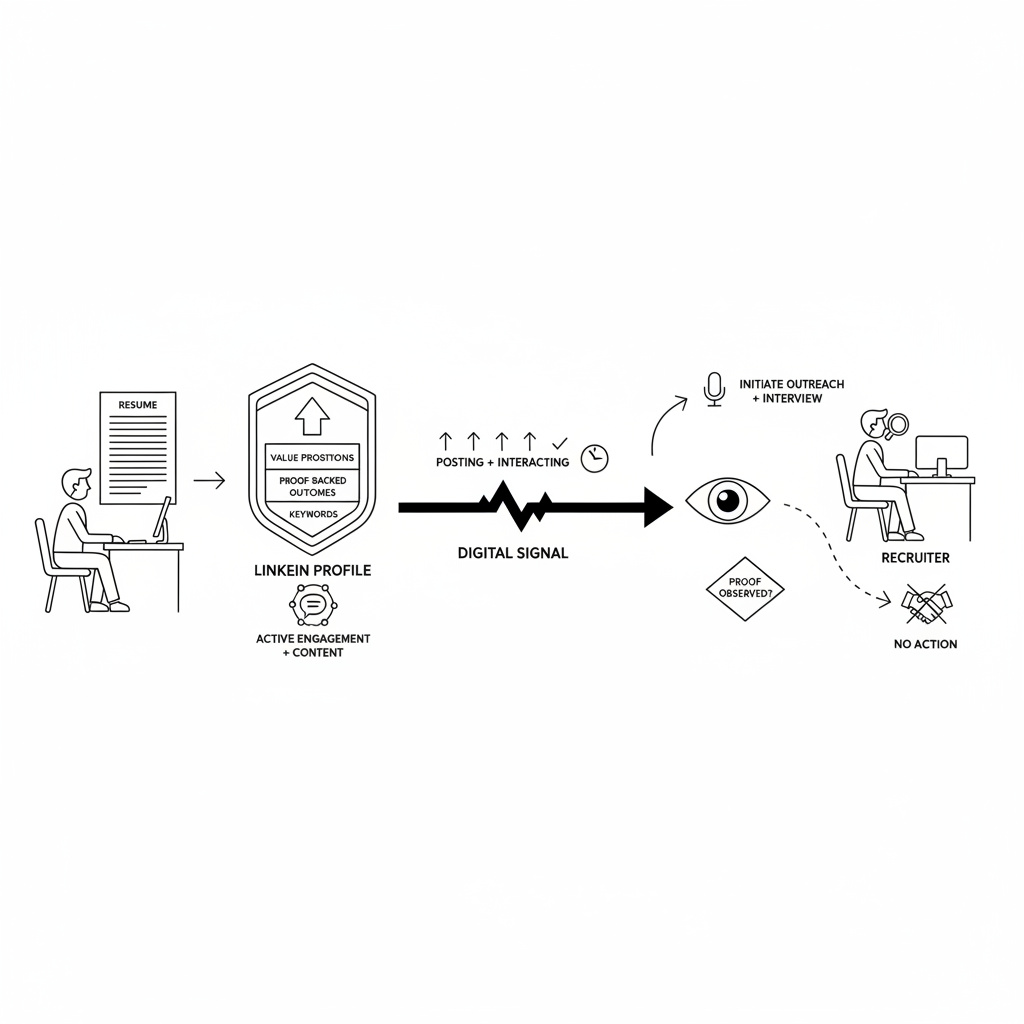
If your resume and online presence disagree, the online version wins, because it’s public, current, and backed by signals like who engages you, what you post, and how you’re referenced. Think of it as moving from a static record to an active signal. That shift is the work.
A resume records the past; your digital brand points to where you’re going. Turning experience into positioning and proof is how you perform on LinkedIn and in ATS.
Make your digital resume work
I’ve seen profiles make or break interest in under 30 seconds, headline, About, top 3 experiences, and Featured sections decide whether someone scrolls or moves on.
Your headline should name your target role and the problem you solve. Example: “Product Operations | Turns messy launches into reliable delivery.” That’s a clear value proposition. In your About section, use 4–6 lines to explain who you help, how you work, and one outcome you’ve driven. Keep it plain. For each role in Experience, lead with a one-line purpose, then 2–3 outcomes. Don’t dump tasks. In Featured, add one portfolio piece, one post with substance, and your personal site if relevant, LinkedIn-first personal branding benefits from visible proof.
Instead of “Responsible for onboarding, ” write “Built a 3-step onboarding kit that reduced time-to-first-task for new hires.” Even without numbers, the mechanism is obvious.
Prove it with outcomes
You don’t need grandiose claims; you need tangible evidence. Proof beats adjectives every time.
Replace “strategic leader” with a short scenario: “Led a cross-team review that retired two low-value projects and freed a team for the launch that mattered.” That’s proof-backed achievement. Swap generic “communication skills” with a real artifact: “Shared a weekly 5-line update that cut status meetings in half.” If you can show an example (sanitized), include it in Featured.
A senior analyst came to me with a pristine CV and a quiet inbox. We tightened her headline around the role she wanted, rewrote her About with two crisp outcomes, and pinned a short case describing how she standardized a messy report process. She posted a brief teardown of a public metric each week. Within a month, she started receiving targeted messages from hiring managers, not viral reach, just the right eyes on the right proof.
Use keywords without sounding robotic
Yes, keywords matter; no, you don’t need to stuff them. Align to the language of the role, then write like a human.
Start with the job titles and core skills you’re seeing repeatedly. Place them in your headline and first line of each role. Then translate into clean sentences: “Partnered with sales to improve renewal workflows” beats a comma pile of buzzwords. That’s skills alignment without keyword stuffing.
Instead of “CRM, lifecycle, cross-functional, enablement, ” try “Improved CRM hygiene with a simple checklist and weekly 10-minute reviews; sales started trusting the data again.” The human detail carries the keyword’s weight.
Post in a way you can sustain
Momentum beats intensity. You don’t need to be a “creator”; you need a steady signal your target audience can recognize.
Aim for one useful post each week and a few thoughtful comments. Choose a repeatable angle: a short teardown, a simple how-to, or a brief lesson learned. That’s your thought leadership cadence. Rotate formats: text post, quick Loom walkthrough, or a clean slide. Keep it short and specific to your target role.
If you’re in revenue ops, post a 6-line “metric audit” on one public company per week: definition, why it matters, how you’d fix a common error. Tag no one; let the content do the work.
Visibility without credibility is noise. Credibility without visibility is invisible. Your digital presence turns experience into a competitive advantage when it’s specific, consistent, and tied to problems your market actually feels.
Stay human while using AI
Use AI for drafts, not decisions. Let it help brainstorm outlines or tighten phrasing, then rewrite in your voice.
Keep your examples true to your context; avoid generic “case study” filler. Read aloud before posting; if it sounds like a brochure, cut it. Protect an authentic voice with human control.
Feed AI a rough bullet list from a project, then ask for three headline options. Pick the one that feels closest, rewrite it in your tone, and add the one sentence only you could write, the detail they can’t guess.
A quick clarity test
Here’s a simple check: ask a peer to read your headline and About and answer, in one sentence, who you help and how. If they can’t do it in 10 seconds, you’re not clear yet. Tighten the words until a non-expert can repeat them, consistent messaging beats clever phrasing.
Reputation is the other side of the coin. Search your name regularly and clean up what you can. If something can’t be removed, outnumber it with credible, professional content over time. Your goal isn’t perfection; it’s a clear signal that matches who you are and the work you want next.
In the end, the game is simple, not easy: show up where recruiters look, make your value legible, and let your activity prove the story your resume can’t fully tell.