

The first look is quiet. No fanfare, no careful read, just a swift pass over your headline, top lines, and a few proof points. It’s not evaluation; it’s triage. The recruiter is asking one thing: Do you look like a safe bet to contact?
If the answer feels uncertain, the scan ends. That decision is fast and, in most cases, final for this search. You don’t lose to a better candidate; you lose to doubt. Understanding that moment changes how you think about your LinkedIn profile credibility entirely.
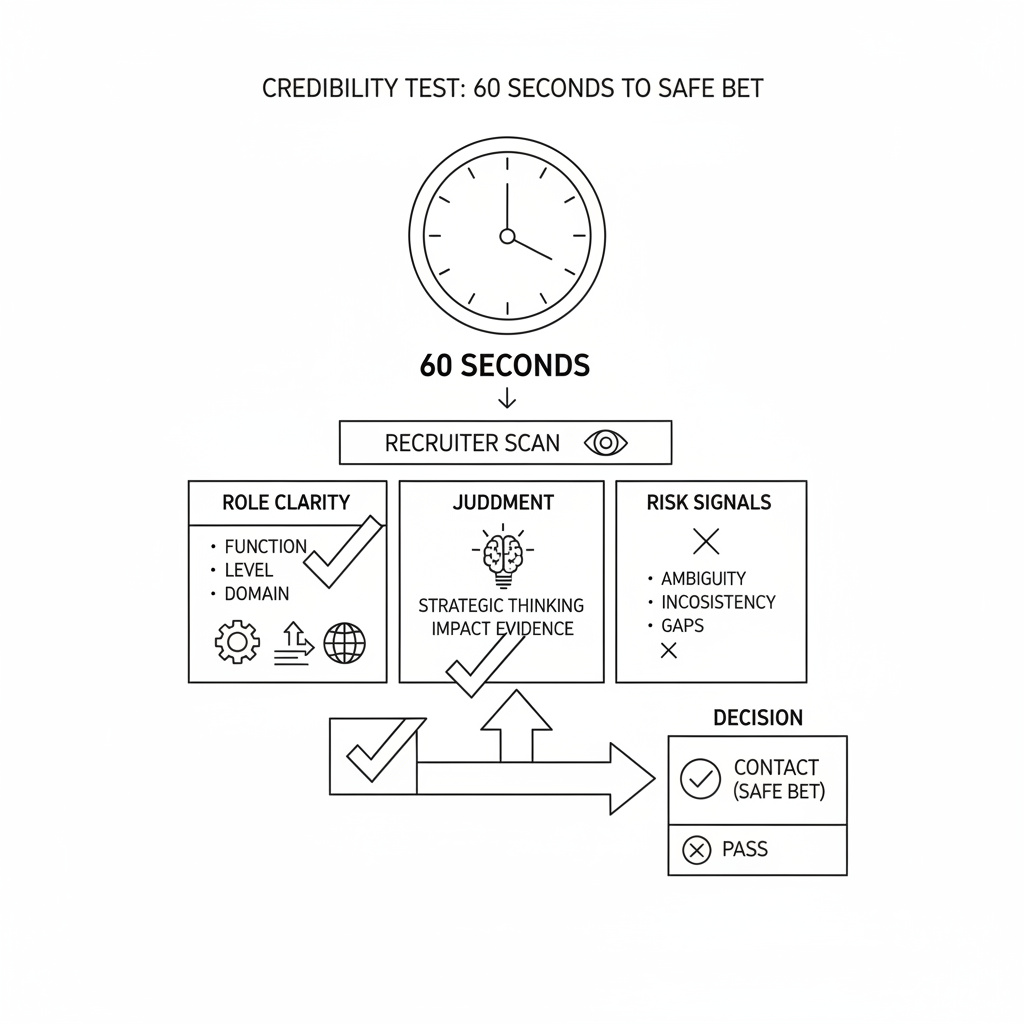
The 60‑second credibility test is the rapid, risk-focused scan recruiters use before deciding to contact you. They look for immediate role clarity, signs of judgment in how you think, and any risk surface. If clarity or confidence breaks, they stop.
TL;DR: Recruiters run a credibility triage in about 60 seconds, decide to contact or not, then move on. They check three signals: Role Clarity, Evidence of Judgment, and Risk Surface. The most common fail is vague seniority. Make one credibility flip: sharpen your headline, add one proof artifact, remove one risk signal.
A quick orientation before we go further: a resume is a record; your profile is direction. My role here is to interpret recruiter behavior so your record reads as credible, fast.
What recruiters actually check
A real scan is boring to watch and brutal in effect. It’s a few glances, a few clicks, and a decision. They’re checking three core signals that determine whether you’re worth the risk of contact.
Role Clarity answers whether they immediately understand what you’re for. Clarity starts at the headline and first two lines. Title, level, domain, and typical scope should be obvious without decoding. If you’re a Director of Product in B2B SaaS focused on GTM and roadmap, say exactly that. When role is crisp, the brain relaxes; contact becomes a low-effort next step. When it’s fuzzy, the effort rises and interest drops. One strong keyword per element is enough, no stuffing, just specificity. “Director of Product, B2B SaaS | GTM + roadmap” beats “Product leader | driving growth.” The first tells me what you’re for.
Evidence of Judgment reveals whether you show how you think, not just what you did. Recruiters aren’t only scanning outcomes; they’re inferring decision quality. A tight one‑liner that names the context, choice, and result does more than five bullets of tasks. Show the trade you made and the constraint you navigated. One short post or project write‑up can signal thinking better than a hundred reactions to news. Judgment reduces perceived training cost and increases trust. “Paused a low‑usage feature to fund onboarding improvements; activation rose, churn eased.” That’s thinking, not boasting.
Risk Surface identifies anything that makes them hesitate. Risk accumulates in small frictions: vague seniority, title inflation, date gaps without a note, typos, buzzwords, inconsistent titles across roles. Any one item can be fine; the sum creates doubt. Recruiters are wired to move away from uncertainty because their time is scarce and their credibility is on the line. Reduce surfaces that force interpretation. Clean beats clever every time. “VP (contract)” next to “Senior Manager” the year before with no context spikes risk. A short note tamps it down.
The vague seniority trap
You’ve seen the headlines: “Experienced strategic leader, ” “Seasoned operator, ” “Transformational executive.” They read like fog. The failure isn’t style; it’s ambiguity. In the scan, vague seniority forces the recruiter to guess level, scope, and lane. That guess is a tax they won’t pay.
Vague seniority breaks all three checks at once. Role Clarity dies because there’s no stated function or level. Evidence of Judgment is absent because adjectives replace decisions. Risk Surface spikes because vagueness is often used to inflate. The triage answer becomes “maybe, ” which is functionally “no.”
“Strategic leader driving cross‑functional impact” versus “Head of Sales Operations, enterprise segment | pipeline governance + quota design.” The first could be anything; the second is a job a recruiter can route.
I once sat beside an agency recruiter scrolling a slate. “Strategic leader” slid by without a click. “Head of Sales Ops” got one. Not because one was better, but because one was legible. The point isn’t to dress up your story; it’s to make the decision easy.
Make one credibility flip
Keep this small on purpose. You don’t need a full overhaul to pass the scan; you need one visible move. Pick one of these three adjustments and execute it cleanly.
Replace adjectives with function, level, and domain in your headline. “Senior Project Manager, healthcare IT | EHR rollouts + vendor governance” works because it’s specific. Add a single public note that shows judgment under constraint, a short post or project summary like “Cut release cadence to stabilize quality; incidents fell; delivery dates held.” Delete the most inflated or vague phrase on your profile. Retire “seasoned strategic leader” or “visionary change agent.”
That’s it. Intentionally incomplete. The goal is movement, not perfection.
Test your profile
Your best check is fast and cold. Open your profile on a phone. Read only the headline and first two lines. Skim one role and one artifact. Then answer, out loud, what a recruiter would decide. The question isn’t what would they learn, it’s what would they decide. If a stranger scanned your profile for 60 seconds and had to make a contact decision, would they feel confident enough to reach out? That’s your LinkedIn profile credibility test.