

Your resume shows what you did. The real question is whether it reveals how you think.
I used to assume good work would speak for itself. Then a client summarized my value as “can run meetings and get stuff done.” It wasn’t wrong, it was the shadow on the wall. The work that created results, how I framed tradeoffs and made calls under pressure, never made it to the surface.
Surface reality is a projection
Surface reality is the visible layer of your career, titles, bullets, brand names. It’s a projection created by deeper structures: your decision patterns, judgment under constraints, and ways of causing outcomes. If the projection is weak or blurry, capable people get misread and mismatched, even while doing strong work.
I learned this the slow way. A warm intro kept landing me as “ops help” when I’d actually been steering decisions on where to invest scarce time and capital. The surface said “ops.” The deeper layer was strategic triage.
What you show includes job titles, company names, task lists, and metrics. What creates those outcomes is how you detect weak signals, frame constraints, and choose. A simple lens: ask whether a smart peer could reconstruct how you think from your public signal. If they can only see what you did, not how you did it, the projection is too flat.
Expose the root layer
For years my resume read like a tidy timeline. Accurate, but it captured history, not judgment. The cost was real: fewer right-fit calls, more time explaining context, and a pattern of being slotted into roles I’d already outgrown.
Try this extraction pass on one project. First, name the constraint, the hard limits you faced, like “12 weeks, 2 engineers, legacy system, no downtime.” Then state the pivotal decision you made: “moved 40% of scope to phase two to secure reliability first.” Finally, tie the call to the result: “99.95% uptime in week 3; volume doubled without incident.”
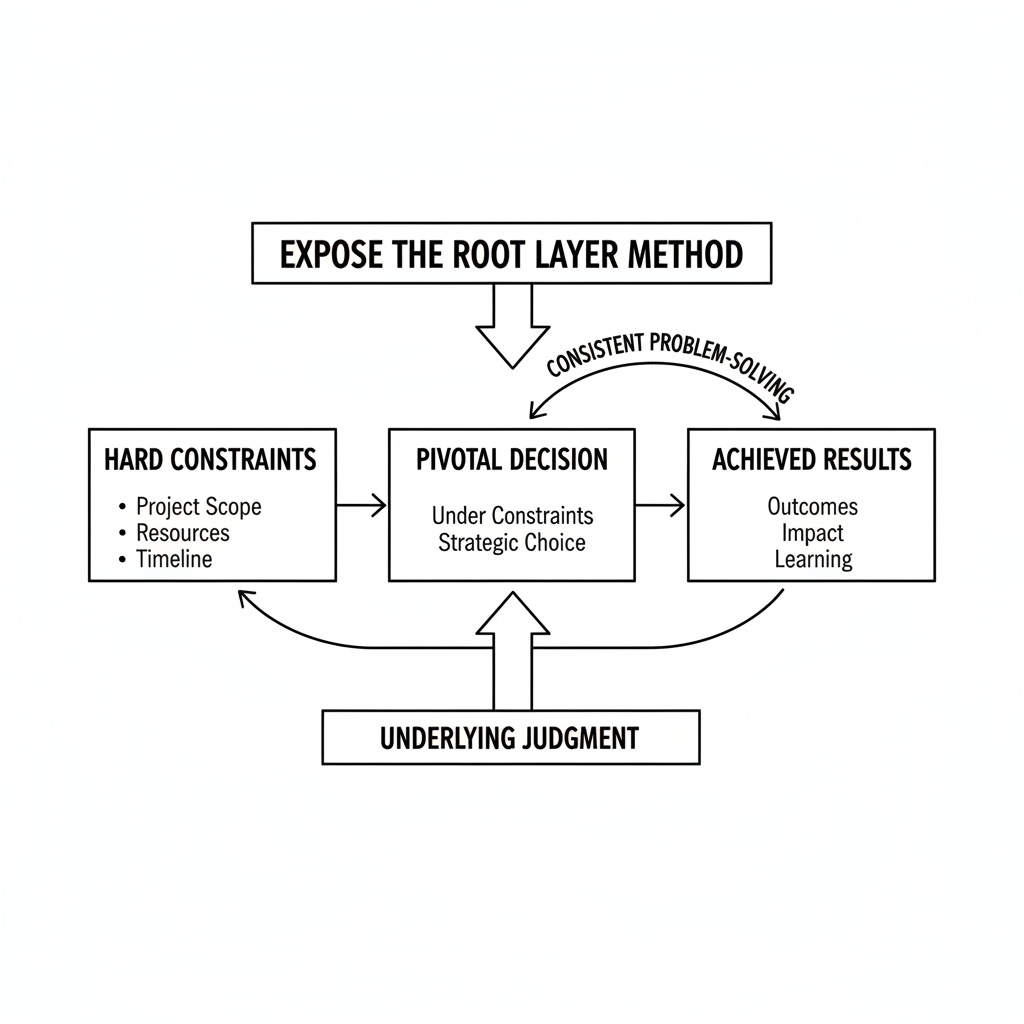
Do that across a handful of projects and you’ll start to see your expertise map, what you do repeatedly when it counts. That’s the generator behind the surface.
Most professionals have depth that never becomes signal; the real work is converting implicit expertise into coherent positioning without self-promotion theater.
Name your spine
A recruiter or peer needs a quick grip on your value. Give them a spine they can repeat: category plus mechanism plus outcome. The category is the lane you operate in as a high-competence professional, “B2B lifecycle marketing, ” “ML reliability, ” or “post-merger integration.” The mechanism is the way you solve hard problems, like “root-cause patterning under noisy data” or “decision pacing with scarce resources.” The outcome is the results your way tends to produce: “stabilized churn in 2 quarters” or “reduced incident minutes by half.”
Build proof without hype
My own turning point came when a founder said, “I think you make decks that calm investors.” I realized my surface artifacts were over-polished and under-explanatory. I rewrote one project around a single decision under fire. The right intros started happening.
Three proof moves work consistently. First, contrast a real constraint with the decision you made, skip adjectives and name the trade: “We chose reliability over feature velocity for 8 weeks to keep enterprise deals alive.” Second, show a small, falsifiable result, not a boast: “20% reduction in handoffs after removing a step we couldn’t staff reliably.” Third, include one sentence on what changed in your decision pattern: “We now stage risk by customer segment instead of channel.”
Consider these micro-examples. An ops leader might write: “With two analysts and a holiday spike ahead, I killed three low-yield campaigns and reallocated support to renewal-critical accounts; churn flattened the next quarter.” A staff engineer could say: “With no budget for a tool, I introduced a 30-minute incident triage and a shared runbook; mean time to recovery dropped within two weeks.” A product marketer might explain: “When trials weren’t converting, I reframed the segment from ‘SMB’ to ‘teams with compliance triggers’; sales cycle shortened because buyers recognized themselves.”
Translate for LinkedIn and ATS
After I had the spine, I stopped performing and started explaining decisions. That’s when peers began to forward my profile to the right rooms.
For LinkedIn as an authority surface, use your headline to show category plus mechanism plus outcome: “Data platform reliability, risk pacing that halves incident minutes.” In your About section, write 3 short scenes, each in the constraint-decision-outcome format. Feature 2 authority artifacts like a teardown and a short write-up, each around 150 words.
For ATS alignment without keyword stuffing, mirror the target lane’s core nouns once in the top third of your resume. Embed keywords inside real decisions, “implemented SOC2 logging to unblock enterprise pilot”, not laundry lists. Keep claim count tight: aim for 3 proof-backed claims per recent role.
Test for defensibility
When I review a draft with a client, I use one quiet test: would a smart peer nod along, or ask for receipts? If I can point to the decision and constraint that made the outcome likely, the narrative holds. If not, we’re still in story mode.
A quick peer-grade check covers three areas. The clarity test asks whether a colleague can repeat your category plus mechanism plus outcome in one sentence after 30 seconds. The credibility test checks whether each claim has a decision and a constraint behind it. The differentiation test asks whether your mechanism sounds like you, or a template.
Strong positioning privileges meaning over optics. When the generator is visible, you don’t need charisma to be legible.
Two reflections before you edit anything else. The surface isn’t “fake”; it’s simply incomplete. Completing it means tracing the cause chain, not writing poetry about potential. Strong positioning privileges meaning over optics. When the generator is visible, you don’t need charisma to be legible.
Surface reality will always compress the depth underneath. Your job is to decide what gets projected and why. When you choose the lens, category, mechanism, outcome, and back it with plain proof scenes, your public signal becomes coherent. The right people recognize themselves in your work, and the rooms you enter change accordingly.