

Quiet excellence is common. Recognition isn’t. If you’ve wondered why weaker work gets more attention, it’s not a conspiracy, it’s architecture.
Markets don’t reward raw competence. They reward clear signals that make competence legible. Most professionals have depth that never becomes signal. The work is real; the translation is missing.
Professionals struggle with visibility because markets see signals, not raw competence. When your knowledge stays unstructured, scattered activities confuse, and no coherent narrative connects category, mechanism, and outcome. Visibility rises when expertise is organized, evidenced, and distributed through a clear identity that peers can quickly recognize and reference.
See the blind spot
You think your work should speak for itself. It does, inside the room where it happened. Outside that room, people only see what’s organized and shared.
The real problem: your value is implicit. Your expertise lives as judgment under constraints, but your public signal is a patchwork of roles, projects, and sporadic posts. To a stranger, that reads as noise. Clarity beats charisma because it reduces the cost of understanding you.
Consider a staff engineer who repeatedly stabilized late projects but stays invisible because her profile lists tools and teams, not the pattern. “I turn failing delivery into predictable release cadence for complex systems.” That single, defensible line would change who recognizes her.
Why professionals struggle with visibility
You don’t lack substance; you lack structure. Most careers accumulate fragments, titles, tools, wins, without a spine. The market needs a coherent positioning that ties three things together: category (what arena you’re in), mechanism (how you create outcomes), and outcome (what reliably changes when you’re involved).
This isn’t performance. It’s translation. When your expertise map is organized and surfaced, peers can place you, decision-makers can recall you, and opportunities can route to you.
A healthcare ops lead writes, “I optimize clinics.” That’s vague. Reframed with structure: “Operational leader for multi-site clinics who reduces patient wait times by redesigning room turnover and scheduling logic.” Same person, clearer signal.
Give peers what they need
Before people hire or recommend you, they run a quick internal test: Can I place you? Can I defend you? Can I remember you?
What a smart peer needs to recognize you starts with a crisp category, “Privacy engineer, ” “Supply chain FP&A, ” “Go-to-market recruiter.” Then they need a visible mechanism: the way you solve under pressure, like “rearchitect flaky release trains” or “triage cash burn with vendor terms.” Finally, they need a proof-backed outcome, not vanity numbers, but repeatable shifts such as “stopped executive churn by rebuilding decision cadence.”
Instead of listing “led cross-functional initiatives, ” say “I create ‘decision rooms’ that collapse 4 weeks of thrash into 5 hours of aligned calls.” It’s concrete, memorable, and easy for a peer to repeat.
Build a structured identity
You don’t need to post daily. You need a coherent identity and a few authority artifacts that travel. The foundation starts with extracting proof without hype.
List three situations where you made judgment calls under constraints, budget, time, regulation. For each, note the decision pattern: “cut scope without cutting promise” or “changed staffing mix to unstick QA.” Turn one into a short case note of 250–400 words. One strong artifact beats 20 thin posts.
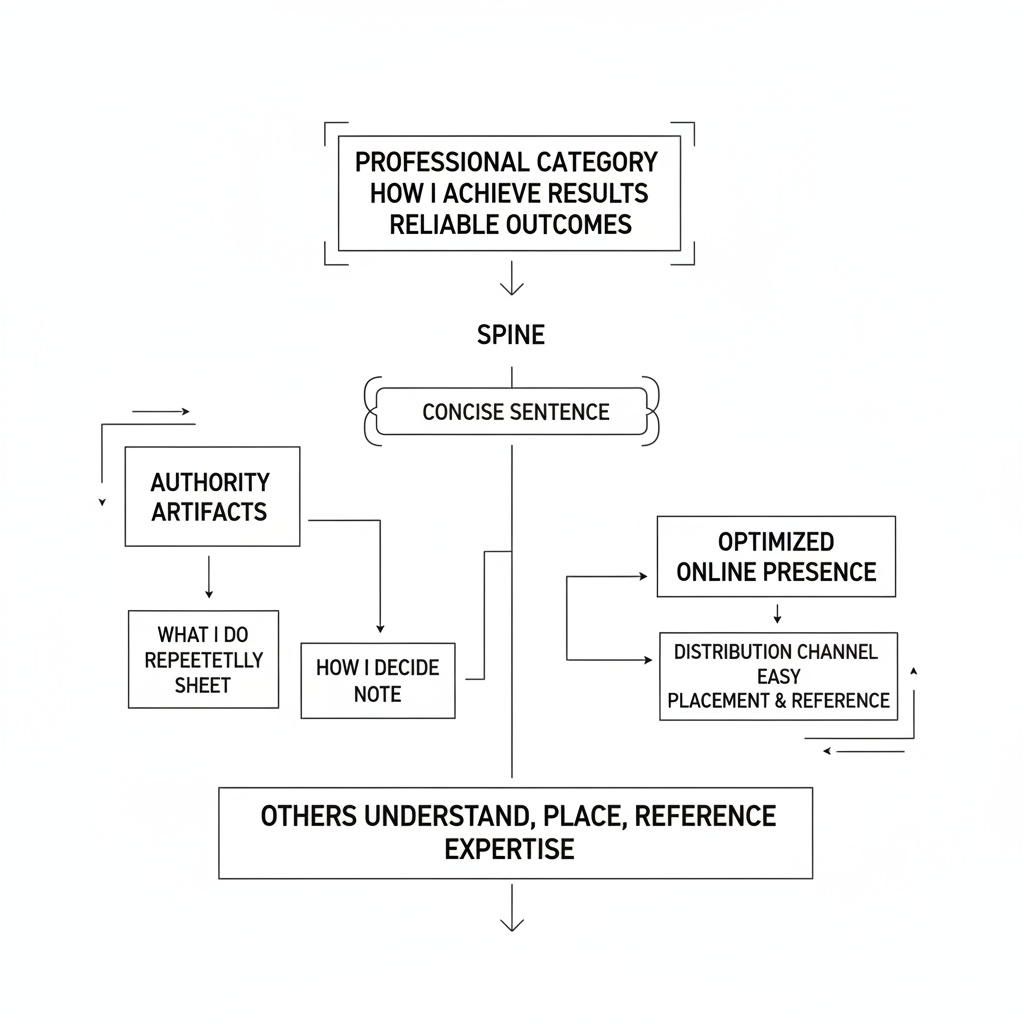
Next, name your spine in one breath. Category plus mechanism plus outcome in a single sentence. Aim for 18–24 words. If it bloats, you’re mixing categories. Then tune your authority surface: LinkedIn headline equals your spine, About section contains 2–3 proof-backed claims, Experience shows patterns rather than task lists.
Map your expertise into 3–5 recurring themes you want to be known for, “failure-to-predictable delivery, ” “clinical throughput, ” “pricing under uncertainty.” These become your cadence for sharing. Set a light distribution schedule: one hour a week to publish one case note, one decision snippet, or one useful template you actually use. Consistency beats bursts.
I used to answer “what do you do?” with a list of projects. I finally wrote a one-line spine and three case notes. Within a month, peers were introducing me with my own sentence. Nothing else changed, just the translation.
Create two portable artifacts: a one-page “what I do repeatedly” sheet covering themes, mechanism, and outcomes, plus a short “how I decide” note featuring three decisions under pressure with their constraints. These are easy to forward and hard to misinterpret.
Translate without performing
You don’t need a stage persona. You need a defensible narrative that sounds like you on a good day.
Write like a peer, not a pitch by replacing adjectives with mechanisms. Not “strategic, ” but “sequenced vendors to cut burn without pausing growth initiatives.” Replace task catalogs with patterns, not “ran standups, ” but “compressed feedback loops from weekly to 48 hours to unstick QA.” Replace hero claims with constraints like “within a frozen headcount” or “under HIPAA limits, ” which signals maturity.
Instead of “thought leader in data, ” try “I standardize event naming, remove silent breaks in pipelines, and cut alert noise so analysts answer product questions on demand.” No hashtags, no theater, just clarity.
Pressure-test your story
Before you publish anything, try to break it. A strong signal survives friendly fire.
Run these checks: Would a skeptical peer nod and repeat it accurately? For each claim, can you point to one artifact? Does your headline match your case notes and experience bullets? Can a colleague describe you in one breath after reading your headline?
A simple test: read your spine out loud to a peer. If they say “oh, like X, ” and X is wrong, refine until they say “got it.”
Respect the real objections
Some niches run on internal reputation. If you’re in a closed, deep domain, your public signal can be light. But even there, a clear one-line spine prevents misrouting.
Worried about a rigid, corporate persona? Keep it principle-driven rather than persona-driven: mechanisms, constraints, and outcomes don’t age into theater. Time cost is real, which is why the bar is low, 1 hour a week, 2 portable artifacts, and 3–5 themes. You don’t need to be prolific; you need to be coherent.
A strong signal without substance is brittle. That’s the point: build from proof, not projection. Use proof-backed claims and a defensible narrative; the rest is noise.
Choose meaning over optics
The market isn’t asking you to perform; it’s asking you to be legible. Convert latent professional value into explicit authority signals, once, then let distribution do quiet work over time. Stop being skilled but unseen. Become structured and discoverable.