
The first scan of your career now happens without you in the room. A recruiter searches your name, skims your LinkedIn, and decides in under a minute whether to keep going.
The point isn’t to go viral. It’s to make that quiet, 60-second check confirm two things: you’re credible and you fit. Your digital resume, your active, searchable online presence across LinkedIn, personal sites, and industry platforms, now functions as the primary tool recruiters use to verify skills, assess fit, and check for red flags before contact. It prioritizes proof, consistent branding, and authentic engagement over static job lists.
See what resumes miss
You can list every role you’ve held and still leave a hiring manager unsure about the value you create. The resume records the past; the web shows how you think today. What the traditional resume doesn’t communicate is your judgment in the wild, what you comment on, how you reason in a thread. It can’t show your relevance to a specific audience or reveal whether you’re speaking their language. Most importantly, it misses your reputation trail, those quiet signals of trust or potential red flags that surface in search results.
A project manager’s resume lists “led cross‑functional initiatives.” Their digital footprint shows a short post series breaking down a tough vendor rollout with lessons learned. The second makes the first believable.
Surface the real signal
Recruiters are scanning for fast signals: relevance, credibility, and risk. They don’t need your whole story; they need a clear one. Make their scan easy with a headline that states your target role and value, not just your current title. Your About section should connect your experience to a specific problem and audience, while your top three accomplishments focus on outcomes, not adjectives.
A resume is a record. A brand is a direction. The shift from career history to clear positioning creates a repeatable message that performs both on LinkedIn and in applicant tracking systems. Your online presence should turn experience into positioning, not a collage of roles.
Make your digital resume work
Think “LinkedIn‑first personal branding”, credible, consistent, and lightweight to maintain. Build this in three focused passes. First, structure your headline, About section, and Featured content to match your target audience and role. Next, pin three posts or links that demonstrate quantifiable outcomes and proof‑backed achievements. Finally, align your skills without keyword stuffing, using the phrasing your actual audience uses.
Consider this example: A mid‑career engineer had great roles but a vague story. We changed the headline to “Platform engineer simplifying scale for fintech, ” rewrote the About with one crisp narrative, and pinned a post dissecting a latency reduction. Within two weeks, inbound messages mentioned that post by name.
Prove it with outcomes
Adjectives create doubt; outcomes create trust. A simple pattern keeps it honest: problem → action → result. Show proof through short post debriefs like “Cut onboarding time by ~30% by removing 3 handoffs; saved support 5 hours/week.” Create before/after snapshots on a personal site with one page, three visuals, and one paragraph of context. Comment with substance on industry threads by adding one practical step or a decision trade‑off you faced.
A customer success lead writes, “Moved churn analysis from quarterly to monthly, flagged one ‘silent churn’ segment, piloted a play, retained 8 accounts.” That single note beats “strategic relationship builder.”
Use keywords like a human
Yes, search matters; no, stuffing doesn’t. The goal is recognizable language that maps to how roles are posted. Mirror phrasing from five to seven relevant job descriptions in your headline, About, and skills. Use one role label consistently across your profile and posts. Put uncommon skills in context with one proof line, not a tag cloud. Instead of “experienced data leader, ” use “Analytics manager for B2B SaaS” and show one line: “Built a 4‑source pipeline to power self‑serve dashboards for sales.” That’s search‑friendly without sounding robotic.
Stay real with AI
AI can help you draft; it can also flatten your voice. Use it for speed, not judgment. Keep an authentic voice with human control by generating a first pass, then rewriting one third of the sentences so it sounds like you. Avoid generic superlatives and keep specifics from your own work. Read your post aloud, if you wouldn’t say it to a peer, it’s not ready.
Credibility online is the sum of small, consistent choices. The web rewards clarity and proof more than polish. The aim isn’t to appear perfect; it’s to be findable and believable.
Stress‑test your story
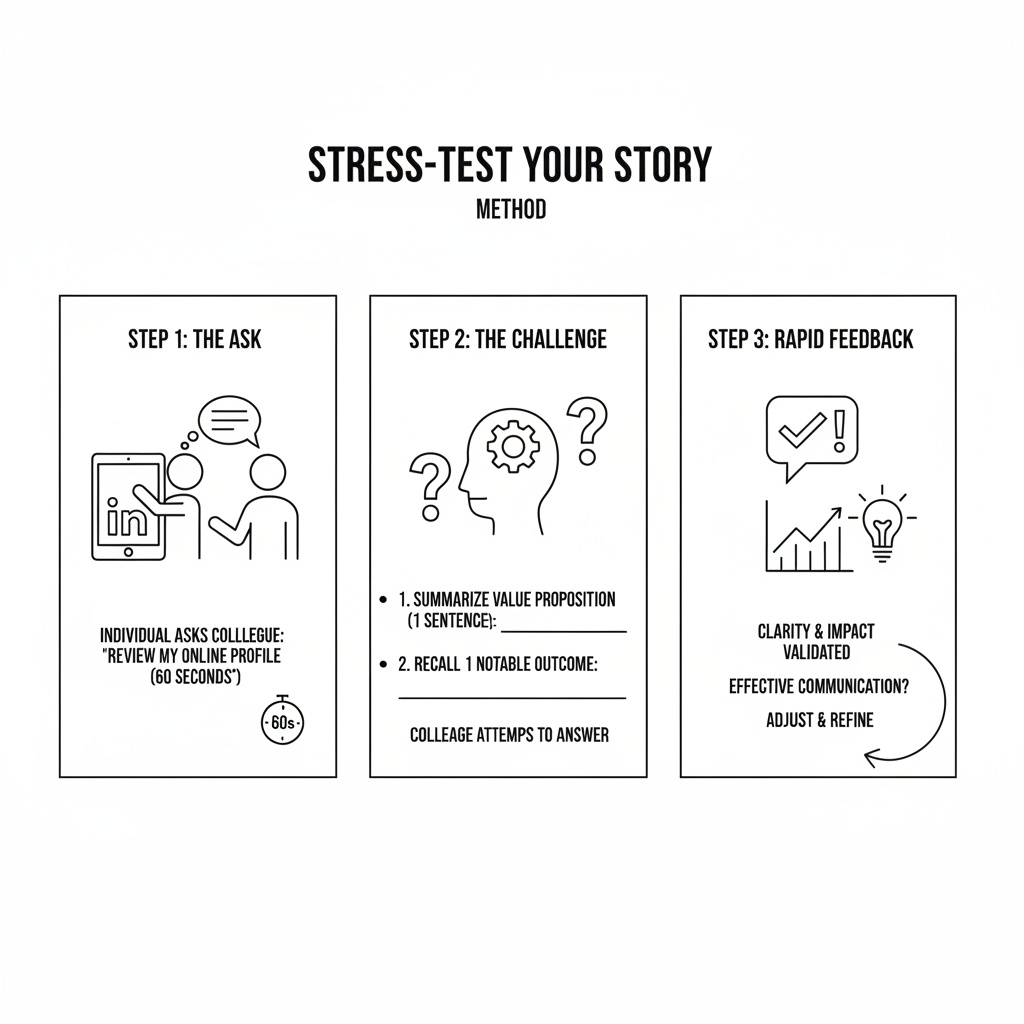
Before you post more, check if your story lands in under a minute. Ask a colleague to skim your profile for 60 seconds, then have them write your value proposition in one sentence and name one outcome they remember. If they can’t, tighten your headline and About until they can.
Put it into motion
You don’t need a content calendar the size of a novel. You need a light, steady rhythm that compounds. Weekly, publish one short post of 120–180 words on a recent problem you solved or a decision you made. Twice weekly, comment thoughtfully on two industry posts by adding one concrete step or a risk to watch. Monthly, spend two hours on a profile and search audit, Google your name, adjust your headline and About, update Featured with new proof, and remove anything that reads like you didn’t write it.
For reputation management, search your name in a private window and on mobile, noting the first five results. Align your headshot, headline, and About across LinkedIn and your personal site for consistent messaging. Pin your strongest proof at the top and unpin anything vague or outdated.
For career pivots, bridge the story in three lines, what you’ve done, what that proves, and why it transfers. “Led hospital workflows for five years; known for reducing wait times. Now focused on healthcare product ops where process and patient empathy meet.” That’s a career pivot narrative without over‑explaining.
Your online presence is now your most visible professional document. Treat it as a living portfolio, credible, consistent, and human, and you turn experience into a competitive advantage that works around the clock.