

Most senior executives discover their career vulnerability only when it’s too late – when the division gets sold, the company restructures, or the market shifts. Internal success and external optionality are different assets, and confusing them creates hidden risk even for high-performing leaders.
I spent twelve years building what looked like an unshakeable career. VP at a Fortune 500, strong internal network, consistent performance reviews. Then our division got sold. Suddenly, my reputation meant nothing to the acquiring company’s leadership team. I had expertise but no external signal. I had results but no portable authority.
Most senior executives operate under a dangerous illusion: that internal success automatically translates to external market value. It doesn’t. Your value might be real, but if it’s invisible outside your current organization, you’re more vulnerable than you realize.
The Hidden Risk in Executive Success
Executive career strategy often focuses on climbing within existing structures rather than building independent advantage. You master your domain, deliver results, and accumulate internal political capital. But this creates what I call “role dependency” – your professional worth becomes inseparable from your current position.
Role dependency manifests in specific ways. When recruiters call, they’re interested in your title and company, not your judgment. When you network, conversations center on your current role rather than your expertise. When disruption hits – reorganization, acquisition, market shift – you discover that your reputation doesn’t travel.
Consider two executives with identical track records. Executive A has strong internal relationships and a reputation for getting things done within their company. Executive B has the same internal success plus a structured external presence: published insights, speaking engagements, industry recognition for their specific expertise. When both face unexpected career transitions, Executive B has options. Executive A has a resume.
“Internal reputation gives you influence within your current system. External authority gives you options beyond it.”
Why Internal Clout Doesn’t Transfer
The gap between internal reputation and external authority isn’t just about visibility – it’s about proof structure. Inside your organization, people know your judgment through direct experience. They’ve seen you navigate complex decisions, solve problems, and deliver under pressure. This creates trust, but it’s contextual and non-portable.
External audiences need different proof. They can’t observe your day-to-day judgment, so they rely on signals: what you’ve written, where you’ve spoken, how you frame problems, what peers say about your thinking. Without these signals, even exceptional executives appear generic in the external market.
This creates an authority gap that compounds over time. Internal reputation builds your influence within your current system, while external authority creates options beyond it. Most executives invest heavily in the first while neglecting the second, creating career fragility disguised as success.
The Cost of Staying Invisible
Invisibility carries compound costs that become visible only during transitions. First, you lose negotiation power. When your value isn’t externally recognized, you can’t credibly threaten to leave, limiting your ability to shape compensation, role scope, or strategic direction.
Second, you become dependent on your current organization’s trajectory. If the company struggles, gets acquired, or shifts strategy, your career moves with it. You can’t easily jump to a peer organization because they don’t know what you bring beyond your title. Third, you miss opportunity flow entirely. The best executive opportunities often come through reputation-based networks. If industry leaders don’t know your thinking, you won’t be considered for board positions, advisory roles, or senior hires at growing companies.
A client recently described this as “golden handcuffs without the gold.” He was successful but trapped, valuable but invisible, expert but unrecognized outside his current context.
Building Portable Authority
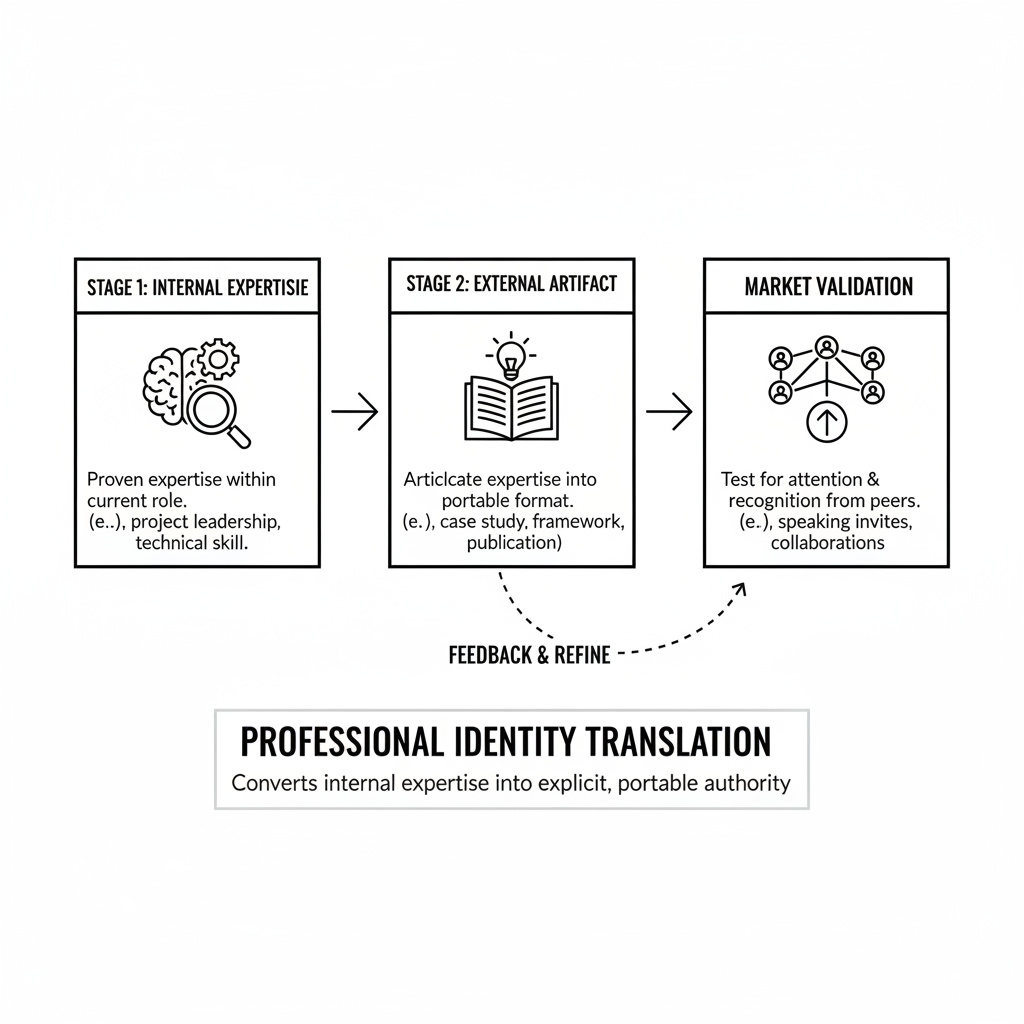
Portable authority starts with externalizing your judgment. Instead of keeping your expertise locked in internal meetings and decisions, you create artifacts that demonstrate how you think about problems in your domain. This isn’t about becoming a content creator or thought leader – it’s about translating existing expertise into external signals.
The executive who regularly solves complex operational challenges can write about decision-making under uncertainty. The leader who’s navigated multiple acquisitions can share frameworks for cultural integration. The strategist who’s built new market categories can articulate how they identify emerging opportunities. The key is proof-backed positioning where your external presence reflects real expertise, not aspirational branding.
“When someone in your industry has a problem you’ve solved repeatedly, they should be able to find evidence of your thinking and track record.”
This connects to what I call the Professional Identity Translation System – converting implicit expertise into explicit authority signals without self-promotion theater. The goal isn’t fame; it’s optionality. You want industry peers to know what you’re uniquely good at and have evidence of your judgment when specific challenges arise.
Your Next Move
Start by auditing your current positioning. Can someone outside your organization quickly understand what you’re uniquely good at? If you left tomorrow, would industry peers know to call you for specific types of challenges? If the answer is no, you’re operating with hidden career risk.
The solution isn’t a complete personal brand overhaul – it’s strategic signal building. Choose one area where you have deep, proven expertise. Create one piece of external evidence: a detailed case study, a framework you’ve developed, or a perspective on industry challenges. Test whether this signal attracts the right kind of attention. Quality external recognition from peers who understand your domain indicates you’re building real authority rather than just noise.
The goal is career security you control, not just career success you hope continues. In an era of constant organizational change, the executives who thrive are those who’ve made their value visible and portable. What would change if your expertise was as well-known outside your company as it is inside?