

Most professionals mistake motion for momentum, chasing headlines while missing the slow forces that actually shape outcomes. Physics and history teach the same lesson: noise cancels, structure persists.
Escape the noise trap
A crowded dashboard blinks; a colleague Slacks a link with red sirens. You feel the pull to react right now. That pull is real, and expensive. Like steering a ship for every wave, you burn fuel and never choose a course.
Here’s the cost I see repeatedly: calendars packed with “urgent” syncs, teams whipsawed by last week’s article, and leaders who sound informed but operate without a throughline. The outcome isn’t momentum, it’s churn. When attention fragments, decision quality drops because there’s no stable baseline for judgment under constraints.
“Structure compounds; noise cancels. Build strategy on the former, capacity for the latter.”
Micro‑example: a consumer app changes pricing after a competitor’s stunt. Two sprints later, they reverse it. Nothing structural moved; they just chased spray.
Spot long-term structural forces
Step off the deck and look at the tide. The forces that actually move outcomes are slow and predictable compared to the daily swell. Three families show up over and over.
Demographics steer demand patterns for years through age shifts, household formation, and migration. A city’s aging population quietly expands home‑care demand for a decade; a viral story about a single clinic doesn’t. Institutional rules gate what’s possible, when, and for whom through procurement norms, compliance regimes, and accreditation paths. Base technology sets capability floors and cost curves through underlying platforms and protocols that determine what’s feasible at scale.
A payments provider tracking multi‑year shifts in merchant risk rules will outmaneuver competitors chasing conference keynotes. The rules determine rollout timing; the keynotes just add commentary.
Run the decade test
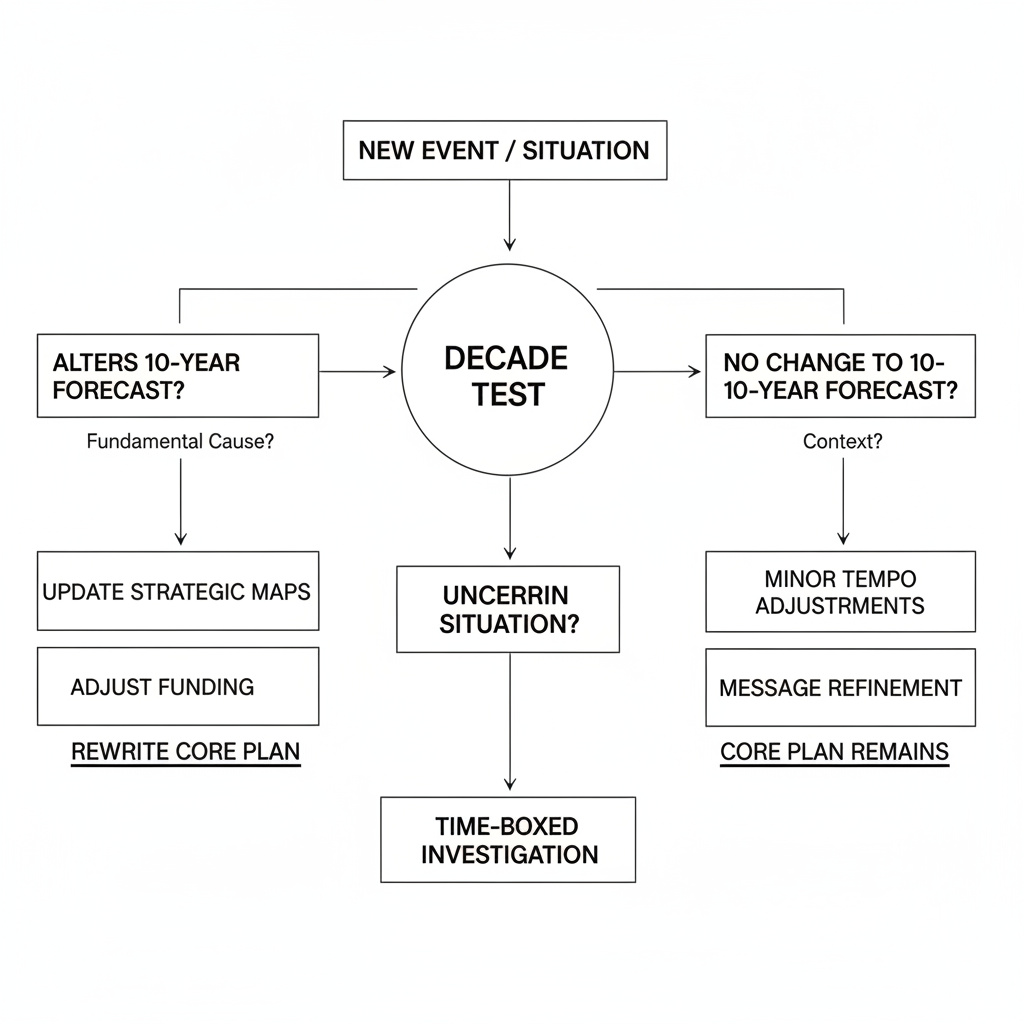
A quick filter beats constant re-analysis. Before you pivot, ask one question: does this event change my 10‑year forecast? If yes, treat it as cause, update your map, funding priorities, and bets. If no, it’s context, adjust tempo or messaging but don’t rewrite the plan. If uncertain, time‑box an investigation, mark a review date, and move on.
In 2019, I advised a B2B founder obsessed with a rival’s weekly announcements. We wrote a one‑page 10‑year view anchored to two structures: buyer compliance hardening and the steady consolidation of their category’s data layer. For six months, we logged “news” against the page. Most items didn’t move the forecast. The team stopped thrashing.
“Within two years, their pricing conversations got easier because they were aligned with how procurement actually buys when compliance tightens.”
The rival’s stunts faded; the structure didn’t.
Signal maturity without theater
People trust operators who can explain the slow truth in clear terms. You don’t need performance; you need proof. This means publishing a short “decade view” for your domain, the two or three structures you believe matter and why, kept plain and defensible. Add one proof‑backed claim per post: a policy change, a cost curve, or a durable customer behavior, plus how it shapes your next decision. Show a decision you made because of it.
That’s an authority artifact: not a boast, a receipt. “We’re prioritizing trust features this quarter because new third‑party risk questionnaires are becoming non‑optional. Here’s the clause pattern we’re seeing, and here’s the release we moved up.” No drama, just clarity over charisma.
Map what you repeat
When you list projects, you capture history. When you surface what you do repeatedly under different conditions, you reveal structure. Look for your decision patterns: the consistent stances you take when stakes, time, and information vary.
Group wins by the constraint you solved, ambiguity, speed, compliance, cross‑team alignment. Note the trigger you watch, whether it’s “new rule enforced, ” “capacity inflection, ” or “unit cost crossing a threshold.” Name the move you make: sequence, who you brief first, what you ignore.
Across three roles, you might be the person who stabilized hairy vendor transitions under time pressure. Different logos, same underlying move: identify the single non‑negotiable, freeze scope creep, and escalate earlier than the culture prefers. That pattern is your quiet moat, and the spine of coherent positioning.
Operate on two clocks
Don’t ignore the short term; integrate it. Think of two clocks on your desk. The operating clock handles incidents, launches, and comms, it respects reality as it shows up. The structural clock anchors commits and narrative to the slow forces you trust.
Keep a single “long line” doc that updates only when something shifts your 10‑year view. Triage headlines into three buckets: act now for safety and security issues, note for later review at planned checkpoints, or ignore when there’s no structural relevance. Schedule a recurring, quiet review with one smart peer, if you can’t defend a change without slides, it’s probably noise.
Yes, some shocks can reshape the map through novel constraints or step‑changes in capability. The decade test will catch that. Yes, many roles are judged quarterly, use the operating clock for that while keeping the structural clock for direction. Yes, you still need to respond to “noisy” events like security breaches. That’s operational hygiene, not strategy.
Hold the long line
Quigley’s point wasn’t romance about destiny; it was sobriety about causality. The long horizon isn’t a pose, it’s a filter that lets the true forces show themselves. Treat noise as weather and structure as climate, building plans on the latter while maintaining capacity for the former. Let your public signal mirror that calm, and watch how clarity compounds over time.