

Some weeks my studio felt like a switching yard, tracks everywhere, nothing arriving on time. Mornings vanished into ideas; afternoons into inbox triage. I wasn’t short on effort. I was short on a routine that protected both the work and the work that gets the work.
A harmonious workflow is a simple, repeatable routine that protects dedicated blocks for creative work and small daily commitments to business development. It trades vague intentions for clear containers, pairs structure with flexibility, and is reviewed weekly so your time, energy, and priorities stay aligned as conditions change.
Name the real tension
On paper I wore two hats, Artist and CEO. In practice, the CEO showed up only when revenue dipped, and the Artist resented the interruption. Once I named that internal tug, the fix stopped being “work harder” and became “give each hat a protected lane.”
Here’s the lens that changed it: I stopped chasing a perfect split and started building containers that made the right thing likely. Discipline wasn’t a punishment; it was the scaffolding that made good days repeatable.
Define the right container
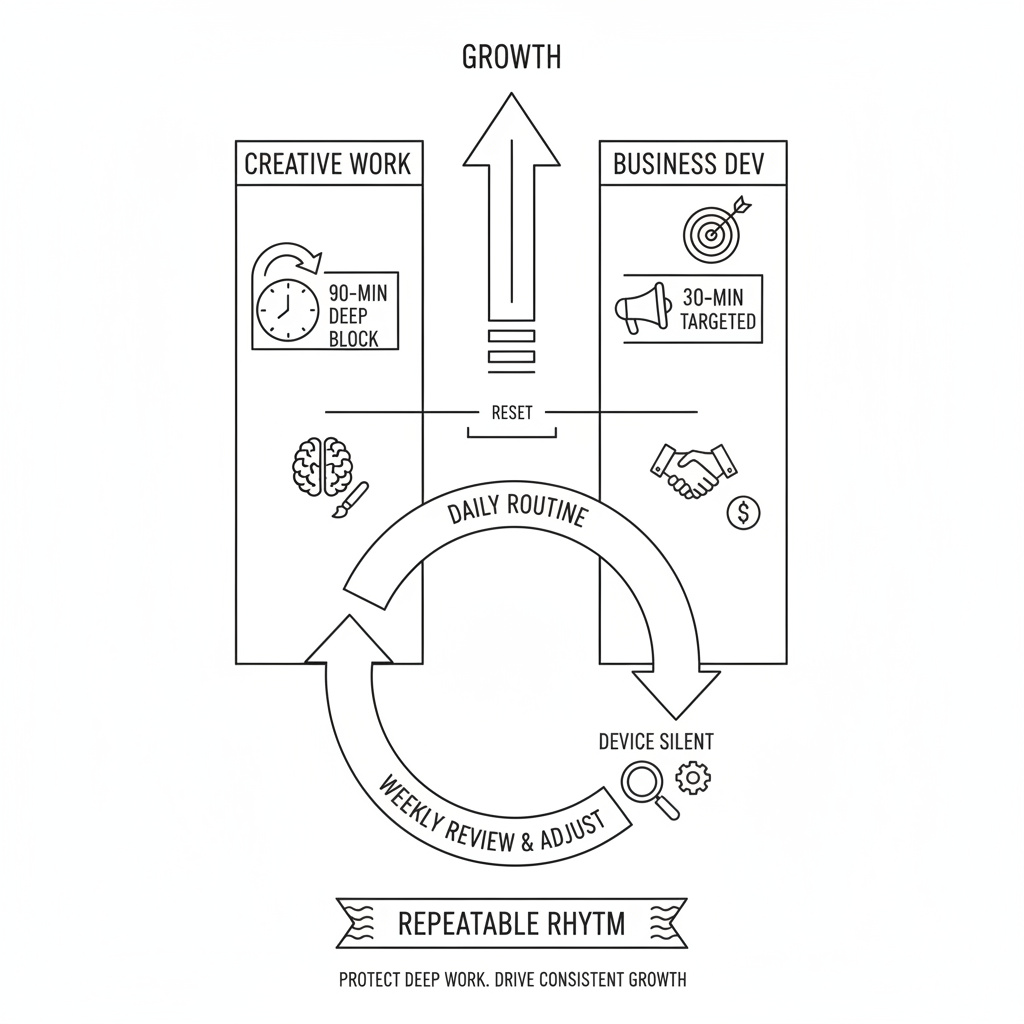
The shift began on a Tuesday when I blocked a 90‑minute creative window and a 30‑minute outreach slot, both before lunch, both phone‑off. It felt small, almost too small. That was the point. Small and keepable beats grand and brittle.
The container works because it lowers switching costs. You know when you’ll go deep and when you’ll grow. You don’t bargain with yourself at 3 p.m. when energy dips. If a client fire pops up, you move the block, not delete it. That’s structure with flexibility.
Balance creative work and business development daily
By Thursday of that first week I learned something obvious the hard way: my best creative hours were leaking into admin. I flipped the order, make first, then market. The day felt lighter because the hardest cognitive lift happened before decision fatigue set in.
Balanced routines turn creative energy and business growth into one workflow, not competing agendas.
What stuck was one deep creative block of 90 minutes early, device‑silent, followed immediately by one business‑development block of 30 minutes that stayed narrow and concrete. Between them, a short reset: water, a walk, no scrolling. The business sessions had to be specific, “send three follow‑ups, ” “draft one outreach note, ” “publish one post”, because longer sessions backfired. I’d over‑optimize CRM tags and postpone the real, uncomfortable asks. Short and specific won.
Show the signal clients notice
When work volumes fluctuate, clients look for one thing: reliability. You don’t need polished slogans; you need a visible cadence that proves you’re steady.
Two tiny signals compound. First, publish on a predictable day with a point of view. Even a 200‑word post builds consistent messaging; it tells people you’re active and serious. Second, send outreach that references proof, not adjectives. “Shipped X last week; result Y” beats “I’m passionate.” Keep a running list of proof‑backed achievements you can cite.
A consultant I advised paused outreach during a six‑week engagement and watched the pipeline dry. We set a 30‑minute daily rule, two warm follow‑ups and one new note, with a Friday recap. Four weeks later, inquiries restarted and two proposals a week became normal again. Not heroic; just consistent.
Let AI handle grunt work
I was skeptical until I used AI to clear the gravel from the road. It drafts first passes I would have procrastinated on, and I keep the human judgment.
Use it for turning voice notes into clean outlines, first‑drafting outreach from a few bullets you control, and summarizing calls into action lists. Keep control by setting constraints before you start: audience, intent, and one example to mirror. Let AI handle formatting and speed; you keep the choices that define your authentic voice.
Run the clarity test
A friend asked me what I was focused on this month. I gave a foggy, five‑topic answer. That night I built a one‑liner and a schedule that matched it. The next morning, decisions felt lighter because the work had a direction I could say out loud.
Start by stating your current focus in one sentence: “This month I’m advancing Project A and filling Q2 pipeline through weekly posts and daily follow‑ups.” Then check your calendar for the next two weeks. Do you see protected creative blocks and the small daily grow slot? If not, the priority isn’t real. Finally, scan your last two posts or emails. Would a stranger know what you’re about and how to engage? If not, sharpen the signal.
Review and adjust weekly
A routine that can’t flex will crack the first time life gets loud. I hold a 45‑minute Friday review: what moved, what stalled, what I’ll change next week. No self‑scolding, just an honest accounting.
I look at energy fit first. Did my deep block land in my best hours? If not, swap it. Then scope: Did I ask too much of a 90‑minute slot? Next week, cut the task in half. Finally, evidence: What proof did I create or ship? Proof, not adjectives, builds credibility.
This is where reflection pays off. You learn your natural rhythms and stop copying other people’s mornings.
Prioritize with a clean cut
When everything matters, nothing ships. I pick projects by two filters: creative heat and business relevance. If a project is hot but off‑strategy, it becomes a weekend sketch or a later‑season bet. If it’s strategic but cold, I shrink the first step until it’s easy to start.
Consider a designer with three concepts and one retainer gap. Choose the concept that demos a skill your target role values, publish a work‑in‑progress post Tuesday, and send it to three potential clients with a short ask Wednesday. That’s positioning and differentiation in motion.
Discipline isn’t the enemy of art; it’s the guardrail that lets you drive faster without drifting off the road.
Keep it human and durable
Some days, the creative block will be messy and the business slot will yield silence. That’s not failure; that’s variance. The win is showing up again tomorrow because the routine is small enough to survive real life.
Protect one deep block for making, one short block for growing, and one short weekly review. Build around your energy, not someone else’s calendar. Adjust as you learn. That’s how you turn experience into a competitive advantage without burning out.