

Behavior feels chaotic until you spot the patterns. People follow scripts, respond to triggers, and slip into familiar roles. Groups amplify simple signals. Once you see the structure, influence becomes architecture, not force.
Most days, behavior feels chaotic. Then you look closer and see the same moves on repeat: a request lands, a role switches on, a decision follows the groove it always follows. That repeatability isn’t an insult to agency; it’s a map.
Here’s the thesis: people follow scripts, triggers, and roles; groups amplify predictable dynamics; influence works through structure, not force. Once the pattern is visible, behavior becomes designable.
See the Real Problem
A quiet scene: you present a strong result and wait for the room to infer your judgment. They don’t. The group latches onto the most legible signal, title, headline metric, brand name, because crowds compress complexity to decide quickly. Your depth stayed implicit; their choice followed the simplest cue.
Consider this: a staff engineer ships a critical fix, but the promo panel recognizes the teammate who wrote the crisp one-page rationale. The artifact, not the charisma, carried the day. Most professionals have depth that never becomes signal.
Spot Scripts and Roles
In one-on-ones, a small trigger flips a bigger pattern. A last-minute ping arrives, and you slide into rescuer mode; the other party relaxes into dependent mode; the decision narrows to “how fast, ” not “whether.” Berne’s lens on recurring roles makes this legible. Cialdini’s triggers, authority, reciprocity, and commitment, explain why a signature block, a prior favor, or a public promise can tilt choices.
Take this micro-example: a product lead who always prefaces tough news with “quick ask” trains the team to grant yeses before details appear. The cue (friendly opener + time pressure) calls a script (agree, then adjust later). Naming it breaks the loop.
Crowds add another layer. As Le Bon argued, groups prefer simple stories and visible certainty. In hiring or funding meetings, crisp labels beat nuanced, wandering narratives. That’s not cynicism; it’s a constraint. Treat it as one.
Design the Influence Structure
When influence is treated as a personality contest, quiet professionals lose. When it’s treated as architecture, they win. The job is to design a path where the desired action is the most logical next step, no pushing.
“Influence, handled with care, is giving constraints a fairer shape. When the structure is honest, persuasion feels like relief, not pressure.”
Use a simple spine: category (what are you in a sentence?), mechanism (how do you reliably create change?), and outcome (what result does that produce?). For instance: “Fraud analytics lead who pairs anomaly detection with human reviews to cut false positives by ~20% while protecting customer experience.” Category sets the lane, mechanism explains repeatability, outcome shows stakes.
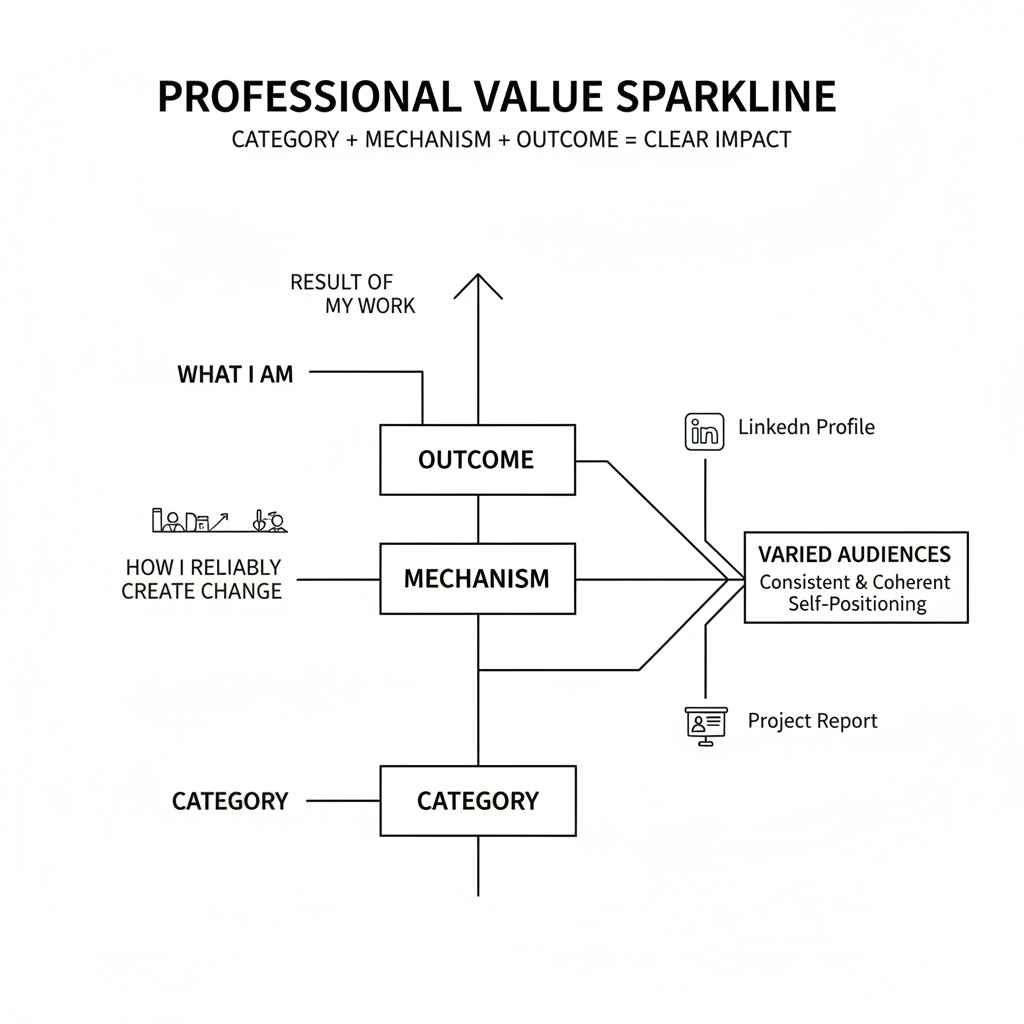
That spine unlocks coherent positioning. It also travels: from a headline to your summary, from a bio to a case note.
Prove Maturity Without Hype
Proof should demonstrate judgment under constraints, not just victory laps. Crowds reward clarity; peers respect tradeoffs. Show both through three simple proof types.
Decision snapshots work well, a six-line note that states context, constraint, options considered, chosen path, and why. A reviewer can skim it in three minutes and grasp your judgment. Before/after boundaries show where you stopped doing X so you could do Y; boundaries signal maturity. Constraint-first cases lead with the constraint you couldn’t change (budget cap, compliance rule), then the adaptation. This reads as credibility, not theater.
I once rewrote a stale case study into a constraint-first memo (“no new headcount; 90 days; two vendor contracts locked”). I spelled out the three options I rejected and why. Peers started forwarding it with “this is how we should think.” The artifact did the persuasion.
Use Predictable Human Behavior
You don’t need to guess what people will attend to. Make it easy to see and verify. For peers, lead with mechanism, then show a concrete before/after boundary, they want to recognize the craft. For committees, put the category and outcome up front; tuck details into a short appendix, they need a fast, fair choice. For crowds, use one sentence that can travel. If a colleague can repeat it accurately tomorrow, it’s working.
Reflect for a moment. People aren’t puzzles to be solved; they’re pattern-makers navigating constraints.
Translate for LinkedIn Cleanly
You can create a strong public signal without performance. Use your headline for category + mechanism + outcome in roughly twelve words. Structure your About section with three short paragraphs, who you are, how you work (one pattern), what results repeat. Skip origin stories.
For experience entries, convert bullets from tasks to decision moments: “Chose X over Y because Z constraint; result.” Instead of “Owned cross-functional initiatives, ” write “Paused a requested feature to meet a hard SLA; shifted team to a two-step triage; incident rate fell while release cadence held.” The judgment becomes visible.
Attach one decision snapshot and one boundary diagram per major win in your projects section. Use plain terms a peer would search for keywords, mirror the role’s language sparingly for ATS alignment without sounding like a template.
Treat Behavior as Design
Once you accept that behavior is structured, scripts, roles, and crowd dynamics, the work gets simpler and more ethical: design honest paths that respect constraints. Name the pattern you’re in, design the path of least resistance toward the right move, and publish artifacts that let peers verify your judgment.
You don’t control people. You control clarity, sequence, and proof. Get those right and predictable human behavior stops being a frustration and becomes a fair, defensible narrative that others can trust.