

A salmon doesn’t wait for the river to come to it; it swims upstream to the source. Picture that as our operating metaphor, half digital, half real, because shaping value early with suppliers, data, and design is how we make downstream wins more certain and harder to copy.
The upstream advantage
Before we optimize yet another downstream campaign or firefight a late-stage cost overrun, it’s worth naming the shift. Upstream Marketing argues the real leverage sits before launch, insight, identity, and innovation decisions that determine performance later. Seeing the Whole Value Stream shows the operational counterpart: map how value actually flows across organizations and fix the sources of waste with suppliers, not after it arrives.
Upstream value creation is the practice of moving earlier in the supply chain, into supplier relationships, design choices, and data flows, to build value before it reaches production and sales. Done well, your contribution becomes part of the product or service itself, making later marketing easier and the advantage harder to imitate.
“Create value upstream so the downstream derivative embeds our value.”
How the mechanism works
Think of two tracks that meet at the customer. The strategy track involves pre-launch choices, who we serve, what promise we make, and what we build into the offer, which determine 80% of downstream ease. The operations track encompasses supplier collaboration, materials, tolerances, and data integrations that determine cost, lead time, and reliability before production begins.
These tracks converge when we co-create with suppliers. If we embed our expertise, a component spec, a data feed, an interface, a process guarantee, into what moves downstream, we don’t have to “sell around” deficiencies later. We’ve already coded our advantage into the flow.
Three mechanisms make upstream focus pay off. First, shape demand at the source through precise insight and identity work, choosing the problem worth solving and the distinct way we solve it. When this is clear, later sales motion benefits from pull, not push. Second, remove waste before it propagates by mapping value streams with key suppliers to expose waiting, rework, and demand amplification. Fixing these early prevents quality and schedule issues from compounding downstream. Third, increase visibility to act in time through shared, timely data that turns intent into coordination. With real-time status, forecasts, and design changes accessible across companies, partners can adjust upstream instead of issuing late-stage expedites.
Tangible patterns that work
Here are concrete examples of embedding value early. An OEM and tier-1 supplier co-design a component interface with tighter tolerances and a diagnostic pin in the connector. Downstream, field failures drop because issues are detected upstream on the line, not by customers. A food brand works with growers to digitize lot-level data and attach QR codes. Downstream, the story becomes credible and traceable; recalls become narrower, and the brand promise is visible without extra marketing. A SaaS product secures read access to an infrastructure partner’s telemetry. Downstream, the product differentiates with a built-in reliability dashboard rather than an after-the-fact report.
In one hardware program, a team paused a price negotiation to run a half-day joint tear-down with its primary supplier. They found a machining step creating unpredictable burrs, then swapped to a supplier-suggested insert and added a simple in-line check. Returns later fell noticeably, not from harder selling, but because the failure mode never left the factory.
“When we feel pressure to discount or expedite, it’s a signal that something upstream is unclear or unstable.”
Digital visibility as coordination tool
Digital isn’t a dashboard; it’s shared line-of-sight. A simple, mutually accessible Kanban for critical parts is often enough to prevent silent shortages. Weekly, time-boxed reviews on open tolerances and data schemas avoid late surprises. Triggered alerts for meaningful upstream changes, yield shifts, spec updates, let teams adjust before costs escalate. This creates synchronized information flow so improvement sticks across organizational boundaries.
Three moves to start
Pick one flow to study by choosing a part, component, or data exchange that routinely creates downstream pain. Walk it with the supplier from order to ship and write the current path in plain language. Co-create one upstream fix by agreeing on a single change that removes a source of variation or confusion, a design tweak, a test added, a shared file spec. Pilot it for one quarter with clear stop/start criteria. When it works, encode the win by baking it into the spec, the supplier agreement, or the shared dashboard so it doesn’t depend on heroics.
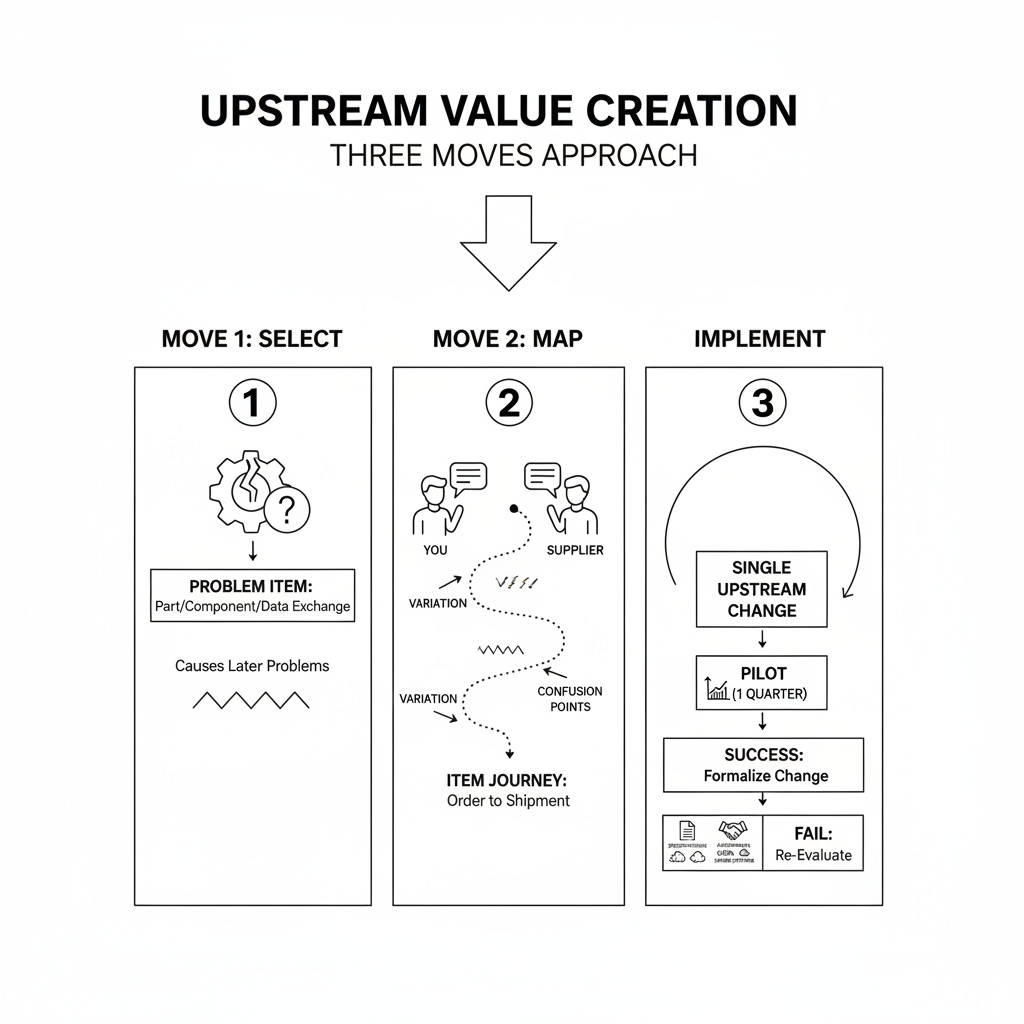
Yes, this requires trust and patience; the benefits often arrive later. But when your value is literally built in, competitors can’t easily copy it. Don’t overreach, one supplier, one flow, one improvement is enough to prove the point without creating dependency.
The downstream trap is seductive because it’s visible and fast. But the work that changes our trajectory happens earlier, where insight shapes what we build, and where supplier collaboration determines what quality and reliability even mean. When we swim upstream together, the current downstream starts working for us, not against us.