

You’ve probably given a long, explicit prompt and still got something that felt generic. The fix isn’t longer instructions, it’s smarter implication.
Start upstream, not downstream
A short scene: you paste an output into your doc and spend 20 minutes sanding edges. Next draft, same routine. The problem isn’t your editing, it’s the input.
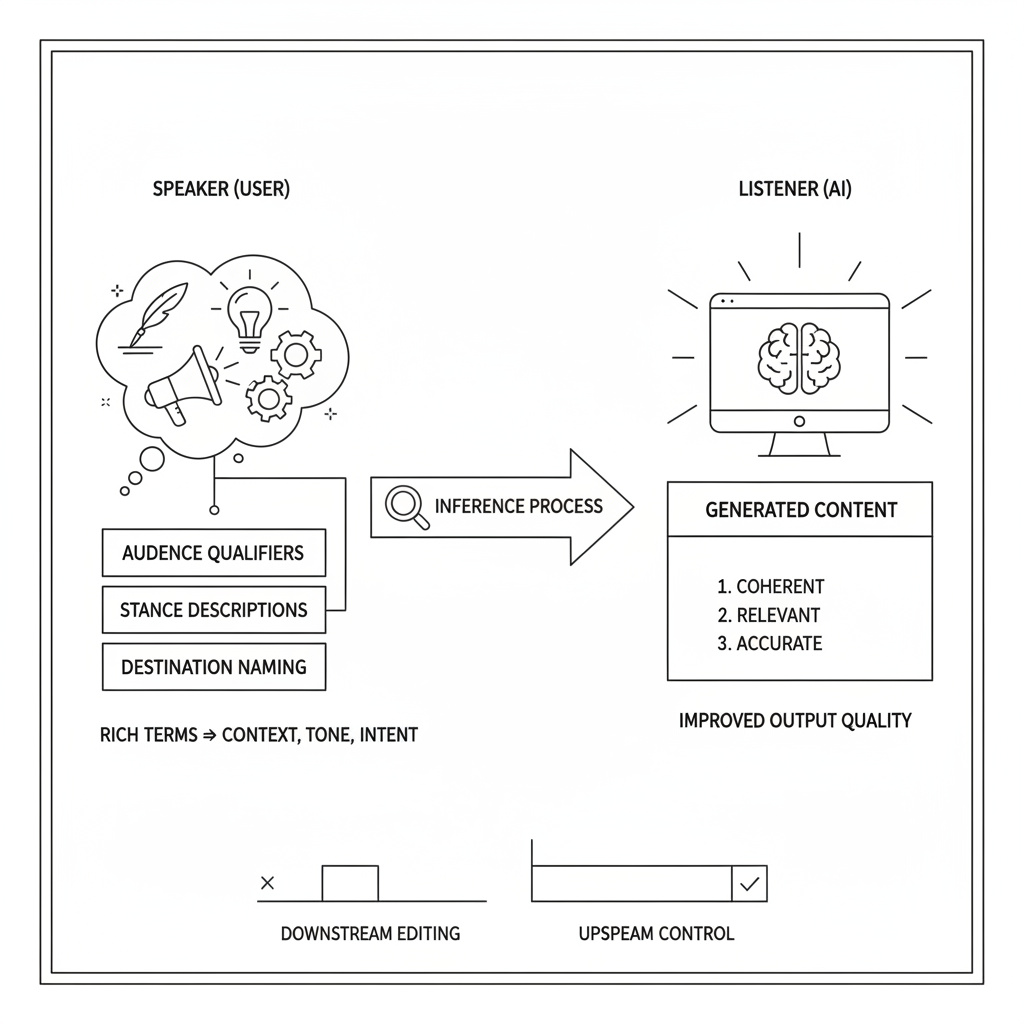
Imply vs infer for AI works like speaker and listener. You imply intent with rich terms and brief context; the AI infers and writes from those clues. Your job is to give signals, the AI’s job is to draw conclusions. Well‑chosen signals guide tone, scope, and audience early, so you spend less time fixing style later.
The distinction matters because it shifts where you put your effort. Imply means to hint at meaning without saying it directly, you fold context into your words. Infer means to draw a conclusion from hints. With AI, you’re the speaker who implies context, tone, and intent. The AI is the listener that infers and writes.
Rich terms steer inference better than long checklists.
One key insight: a single well-chosen phrase carries context that a paragraph of rules can’t match. “Board-level concise, ” “operational turnaround, ” or “first‑time manager” each pack dense meaning that shapes the AI’s inference without micromanagement.
Shape the inference with rich terms
You don’t need more bullets, you need denser clues. Three high‑leverage moves work consistently. First, name the audience with a qualifier: “busy hiring manager, ” “principal engineer who dislikes fluff, ” or “non‑technical founder.” Second, name the stance: “operator‑led, ” “proof‑before‑adjectives, ” or “board‑level concise.” Third, name the destination: “clear value proposition in the first two lines.”
Micro‑example for technical writing: Instead of “Explain Kubernetes networking, ” try “Explain Kubernetes networking to a backend engineer joining mid‑project, skip 101, focus on day‑two issues and failure handling.” One sentence creates a very different inference.
For LinkedIn‑first personal branding, this upstream control becomes especially valuable. “Write a LinkedIn summary” versus “Write a LinkedIn summary for a product leader moving from startup chaos to enterprise scale, measured, calm, proof‑first.” The second line implies audience, stance, and tone in 19 words.
Where AI helps, and where you stay in control
You can let the AI draft shape, but you hold the voice. That balance saves time without surrendering authorship. Use AI to infer structure from your clues, sections, order, emphasis. Keep control of the signature: word choice, cadence, and what you refuse to say.
Most “bad AI” isn’t bad; it’s obedient to thin signals. When you sound uncertain, it fills gaps with clichés. When your implication is sharp, the output tightens without you micromanaging. For precise, technical tasks, direct instructions can be faster. But for persona, tone, and positioning, implication beats rules.
Micro‑example for resume writing: “Improved site reliability” versus “Stabilized checkout during peak traffic, zero incidents for two quarters after load-path fix.” The second line implies scale, risk, and ownership. That’s friendly to an ATS-optimized resume and to a human reader.
Make it tangible with two prompts
I used to spend long sessions rewriting bland bios. The shift was simple: write two prompts side by side, one command‑heavy, one implication‑rich, and pick the better draft.
Command‑heavy: “Write a professional bio. Tone: confident. Include metrics. Mention leadership.” Implication‑rich: “Bio for a calm operator who scales messy teams into predictable machines; audience is time‑pressed VPs; voice is steady, proof‑before‑adjectives; open with one concrete turnaround.”
Nine times out of ten, the second draft needs fewer edits because the stance is baked in. That’s the quiet efficiency of upstream control.
When outputs drift, revise the signal, not just the length.
A client asked for a punchier headline. We kept missing until I implied the audience (“Series B board and recruiters”), the stance (“quietly decisive”), and the proof style (“single decisive turnaround, then brevity”). The next output landed without a rewrite.
A simple test to diagnose clarity
Before you hit generate, read your prompt aloud and check three things in under one minute. Make sure the audience is named once, with a qualifier (“principal engineer who dislikes fluff”). Confirm the stance is stated in 3–5 words (“proof‑before‑adjectives”). Verify the destination is named (“first two lines state the offer”).
If any piece is missing, add one rich term or a tight example. Then generate. If the AI misinfers, don’t add ten rules. Change one implication.
Tactical example for career pivot narratives: “I’m moving from sales to product; write a summary” becomes “I’m moving from quota-carrying sales to product, translate discovery, objection‑handling, and pipeline prioritization into roadmapping value; skeptical PM audience.” That implication helps the AI connect experience to positioning.
You turn experience into a competitive advantage when the clues you give are unmistakable. Think like a precise speaker: imply audience, stance, and destination in plain language; let the AI infer the rest.