

Executive authority has migrated from private boardrooms to public digital signals, and leaders who haven’t adapted are losing control of their professional narrative before they realize it’s gone.
I used to believe my work would speak for itself. Twenty years building teams, turning around divisions, sitting on boards, surely that track record would generate the right conversations and opportunities. Then I watched a peer with half my experience land a board seat I’d been quietly pursuing for months. The difference? When the search firm Googled our names, his first page told a coherent story of strategic thinking and industry insight. Mine showed a sparse LinkedIn profile and a few conference mentions buried on page three.
The New Invisibility Problem
Executive presence used to mean commanding a room, the right handshake, the measured pause before speaking, the ability to shift energy with a glance. That still matters, but it’s no longer sufficient. In a networked economy where decisions happen across distributed teams and opportunities flow through digital channels, invisible authority is diminished authority.
Consider how executive search actually works now. Before any recruiter calls you, they’ve already formed an impression based on your digital footprint. Board members research potential partners through search and social signals. Investors evaluate management teams by scanning their public positioning. Your expertise exists, but if it’s not visible and coherent online, it might as well not exist for these crucial interactions.
The cost of digital invisibility compounds over time. You miss speaking opportunities because conference organizers can’t quickly assess your expertise. Strategic partnerships stall because potential collaborators can’t easily understand your value proposition. Top talent chooses competitors whose leaders appear more forward-thinking based on their public presence.
Why Your Authority Isn’t Translating
Most executives approach digital presence backwards. They think about what to post rather than what story their existing expertise should tell. This leads to either radio silence or sporadic content that feels disconnected from their actual strategic thinking.
The real issue is translation, not creation. You already have judgment, decision patterns, and insights that differentiate you. The challenge is converting these implicit assets into explicit signals that work across digital channels. Your LinkedIn profile shouldn’t just list your roles, it should demonstrate how you think about complex problems. Your occasional industry comments shouldn’t be throwaway observations, they should reinforce a consistent perspective on where your sector is heading.
“Your expertise exists, but if it’s not visible and coherent online, it might as well not exist for the interactions that matter most.”
A manufacturing CEO I know struggled with this translation problem for months. His turnaround expertise was evident to anyone who worked with him, but his digital presence suggested generic operational competence. Once he started sharing specific decision frameworks, like his approach to evaluating automation investments during economic uncertainty, his profile began attracting the right kind of attention from private equity firms and board search consultants.
Building Coherent Digital Authority
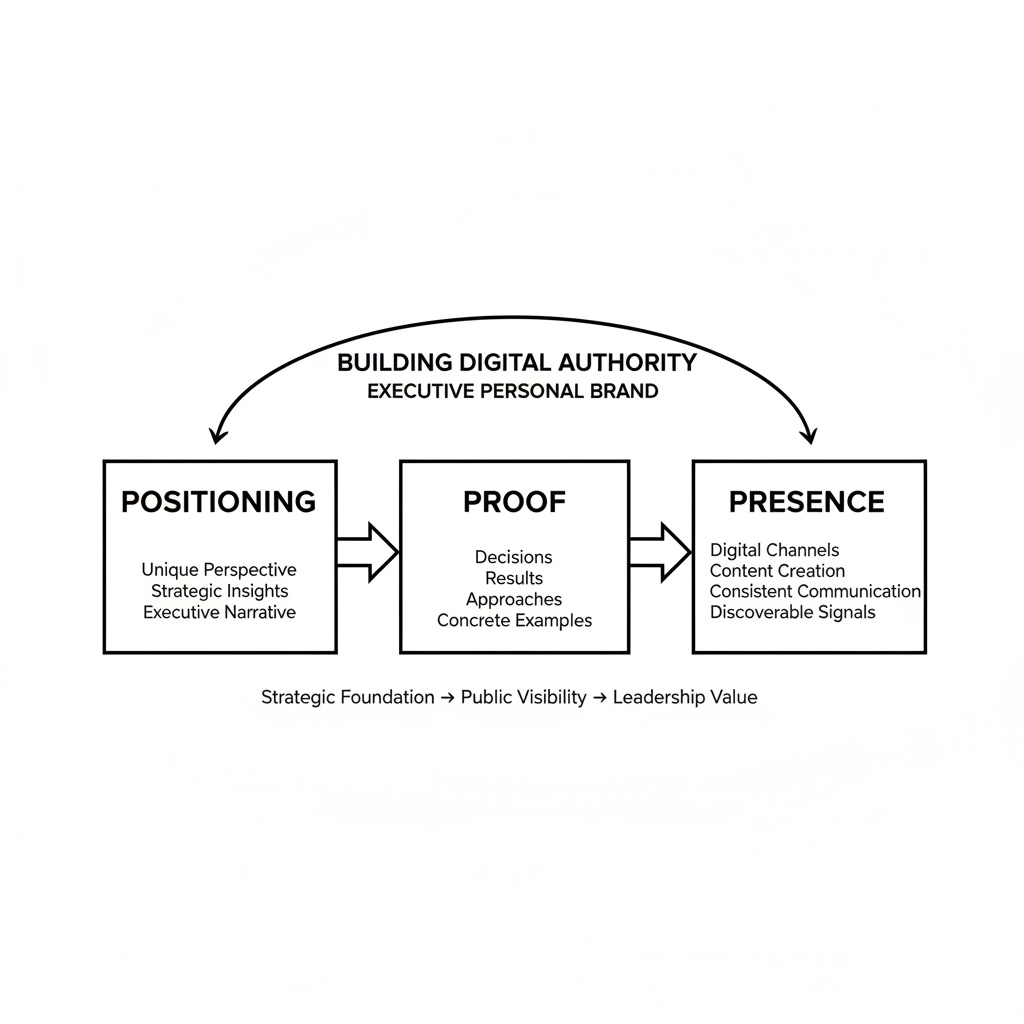
Effective executive personal brand development follows a clear sequence: positioning first, then proof, then presence. Most executives skip straight to tactics, posting on LinkedIn, updating their bio, speaking at conferences, without establishing the strategic foundation.
Positioning means defining your unique angle on industry challenges. What do you see that others miss? Where do you consistently make different decisions than your peers? This isn’t about manufacturing differentiation, it’s about articulating the perspective that already guides your leadership. Proof involves identifying the artifacts that demonstrate this positioning. Which decisions showcase your judgment? What results validate your approach? How do you translate complex situations into clear strategic choices?
Presence is the systematic expression of positioning and proof across relevant channels. This might mean optimizing your LinkedIn profile to reflect strategic thinking, contributing thoughtful comments to industry discussions, or accepting speaking opportunities that reinforce your expertise area. The key is consistency, every touchpoint should strengthen the same narrative about your leadership value.
Your Strategic Signal Audit
Start by conducting a simple visibility assessment. Google your name and evaluate the first page results as if you were a search consultant or potential board member. What story do these results tell about your expertise and judgment? Is there enough signal to understand your strategic value, or do the results suggest generic executive competence?
Next, identify your implicit expertise patterns. What types of decisions do you make repeatedly? Where do colleagues consistently seek your input? What industry shifts do you see before others? These patterns represent your natural positioning, the perspective that already differentiates your leadership. Finally, audit your proof points. Which specific results demonstrate your judgment in action? What decisions showcase your strategic thinking? How do you explain complex tradeoffs to boards or investors?
“The goal isn’t becoming a content creator, it’s ensuring your existing expertise translates into clear, discoverable signals that work in a digitally-mediated business environment.”
The goal isn’t becoming a content creator or thought leader in the traditional sense. It’s ensuring that your existing expertise translates into clear, discoverable signals that work in a digitally-mediated business environment. Your authority is real, the question is whether it’s visible to the people and opportunities that matter most. In today’s networked economy, invisible expertise is increasingly irrelevant expertise, regardless of how substantial it might be.