

As AI floods professional channels with generic content, the executives who stand out aren’t the ones with perfect prose, they’re the ones whose content reveals how they actually think.
I used to think polished was better. Every piece of content needed to sound perfect, corporate-approved, and indistinguishable from what any other executive might say. Then I watched a colleague’s LinkedIn post get 50x more engagement than mine, not because it was more polished, but because you could see his actual thinking process.
Leadership in the age of AI means distinguishing your genuine expertise from synthetic noise. As artificial intelligence floods professional channels with plausible-sounding content, executives who clearly externalize their thinking, judgment, and decision-making rationale gain outsized trust and influence.
The Signal Crisis Hits Leadership
Last month, I counted twelve nearly identical “leadership lessons” posts in my LinkedIn feed. Same structure, same platitudes, same generic insights. The authors were all accomplished executives, but their voices had been flattened into algorithmic sameness.
This is the cost of the AI content explosion. When everyone can generate professional-sounding text instantly, the value of that text approaches zero. What becomes scarce, and therefore valuable, is verifiable human judgment. The kind that shows trade-offs you’ve actually wrestled with, constraints you’ve navigated, and reasoning you’ve developed through real experience. The executives who stand out now aren’t the ones with the most polished prose, they’re the ones whose content reveals how they actually think.
Your Reasoning Process Is Your Authority
Real authority in an AI-mediated world comes from visible reasoning. Not the final decision, but the path to it. Not the perfect answer, but the quality of thinking that produced it.
Consider two LinkedIn posts about a strategic pivot. The first says: “We’re excited to announce our new market focus. This aligns with our core values and positions us for growth.” The second says: “We’re shifting from enterprise to mid-market because our sales cycles were averaging 18 months, our win rate dropped to 12%, and three competitors launched similar solutions. The mid-market moves faster and values our specific automation capabilities more than enterprise buyers value our customization.”
The second post reveals judgment. You see the metrics that mattered, the competitive pressure, the specific trade-offs. Even if you disagree with the decision, you can evaluate the thinking.
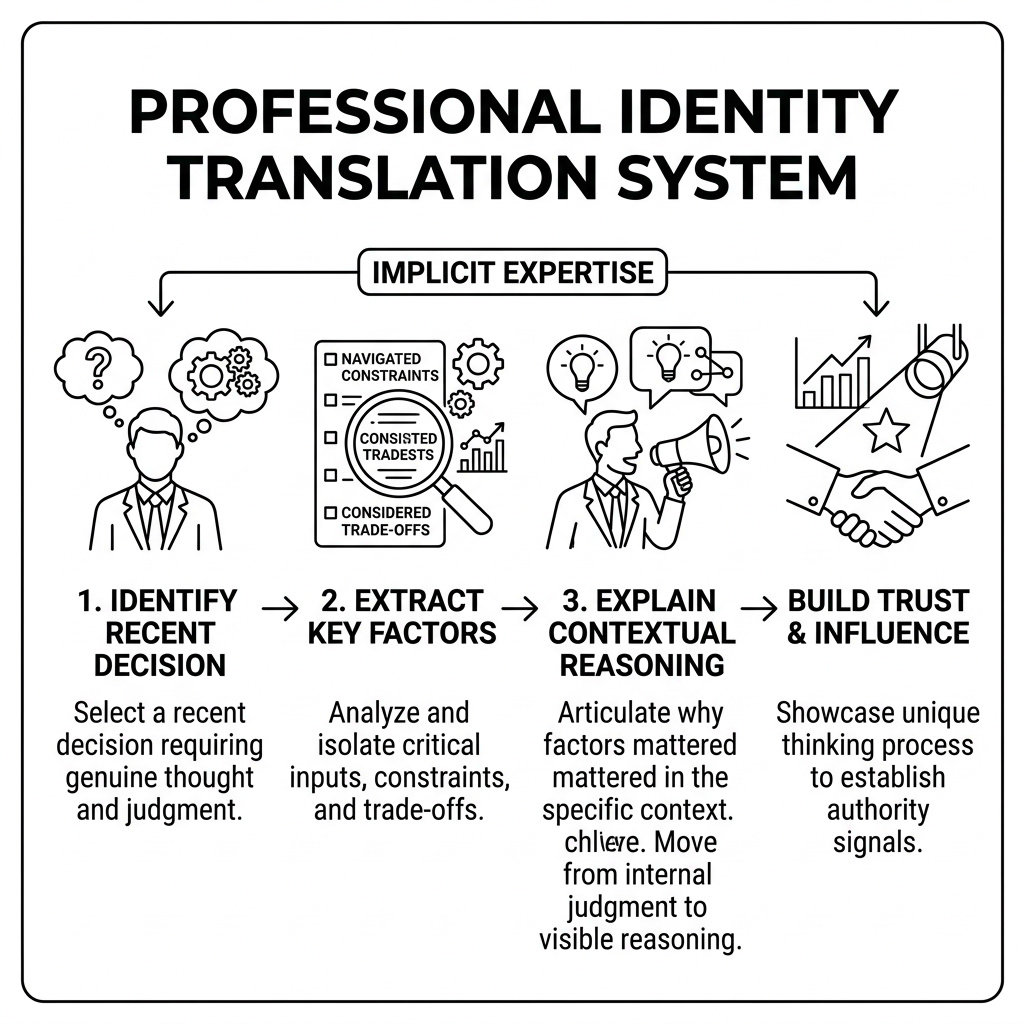
This connects to what I call the Professional Identity Translation System, converting your implicit expertise into explicit authority signals. Most executives have sophisticated judgment that never becomes visible signal. The gap between what you know and what others can perceive creates missed opportunities for influence and trust.
Making Your Leadership Signal Unmistakably Human
I started experimenting with showing my reasoning after that colleague’s post success. Instead of announcing decisions, I began explaining the factors that shaped them. Instead of sharing insights, I described the situations that generated them.
The shift felt risky at first. Showing your thinking means revealing uncertainty, admitting constraints, acknowledging what you don’t know. But that vulnerability became credibility. People could see I was grappling with real complexity, not dispensing generic wisdom.
One post about a hiring mistake got more meaningful responses than six months of polished content. I described the specific signals I’d missed, the questions I should have asked, and how I’d changed my interview process. Founders reached out to share similar experiences. Two asked for advice on their own hiring challenges.
Your expertise isn’t just what you know, it’s how you think through problems others find difficult.
When you externalize that thinking process, you create authority that AI can’t replicate because it’s grounded in your actual experience.
The Efficiency Paradox of Authentic Content
Here’s what surprised me most: showing my reasoning didn’t require more time than generic posting. It required different attention. Instead of trying to sound impressive, I focused on being useful. Instead of crafting perfect sentences, I captured real thinking.
The process became straightforward: identify a recent decision, extract the key factors that shaped it, and explain why those factors mattered in that context. No elaborate storytelling, no inspirational framing, just the actual logic of someone who’s solved this type of problem before.
This approach scales because you’re not generating new content from scratch. You’re externalizing cognition you’ve already developed. Every strategic decision, every problem you’ve solved, every pattern you’ve recognized becomes potential material. The challenge isn’t creation, it’s capture and structure. For executives worried about time investment, this is the crucial distinction. AI can generate endless generic content quickly, but capturing and structuring your genuine expertise is both efficient and valuable.
What This Means for Your Authority
If you’re an executive whose expertise remains largely invisible, you’re facing a choice. As AI makes generic content free and abundant, your competitive advantage lies in the one thing algorithms can’t replicate: your actual judgment, developed through real experience, applied to specific contexts.
Start with one decision you made recently that required genuine thinking. Instead of announcing the outcome, explain the factors that shaped it. What constraints did you navigate? What trade-offs did you consider? What would you do differently with different constraints?
That’s your authentic signal. It’s defensible because it’s genuinely yours. It’s valuable because it reveals how you think, not just what you think. And it’s efficient because you’re not creating new expertise, you’re making existing expertise visible. The question isn’t whether you have valuable judgment worth sharing, if you’re in a leadership role, you do. The question is whether you’ll let that judgment remain implicit while AI-generated content dominates the channels where trust and influence are built.