

For three years, I stared at my LinkedIn profile like it was written in a foreign language. Every update attempt hit the same wall: how do you represent yourself when you don’t know who you are professionally?
The “chicken and egg” problem is real. You need a story to write a profile, but feel you need the profile to discover your story. Without your own narrative, you default to being defined by your current employer or role. Breaking free requires identifying where you are now (Point X), where you’re going (Point Y), and what you’ve learned along the way (Value Z).
The Trap I Was In
I kept putting off the profile update because I couldn’t answer a simple question: If you were to present yourself to a general audience, what would you say? The honest answer was uncomfortable. I would default to my job title, my company’s mission, my boss’s priorities. I had become professionally invisible, competent within my role but undefined outside of it.
This is what happens when you lack your own narrative. You fall into what I now recognize as “system default”, your identity gets absorbed by whatever structure you’re operating within. Your LinkedIn profile becomes a collection of other people’s language describing other people’s goals.
The cost was becoming clear. Recruiters couldn’t see past my current title. Potential collaborators had no sense of my judgment or expertise. I was professionally capable but publicly illegible.
The Moment Everything Shifted
The turning point came during a conversation about building a “personal copywriter and presentation agent.” Someone suggested I just update my LinkedIn profile to reflect where I am now. My immediate response: “Yeah, chicken and the egg.”
Then they asked the question that changed everything: “If you can identify it, you can stand apart from it. What would you say if you had to present yourself to a general audience?”
That’s when I realized the chicken-and-egg problem was actually a translation problem. My expertise was real, I just hadn’t learned how to convert implicit professional value into explicit public signals.
What I Tried (And What Actually Worked)
My first attempts were disasters. I tried copying successful profiles from my industry, but the language felt foreign. I attempted the standard “passionate about X, experienced in Y” formula, but it sounded like everyone else.
What finally worked was a simple structure someone suggested: Peg it at Point X, have a vision for Point Y, talk about your experience along the way, Value Z. Point X represents where I am now professionally, not just my title, but the type of problems I solve and decisions I make. Point Y captures the direction I’m moving, the next level of impact or responsibility I’m building toward. Value Z encompasses what I’ve learned that others might find useful, the patterns I’ve recognized, the mistakes I’ve made, the judgment I’ve developed.
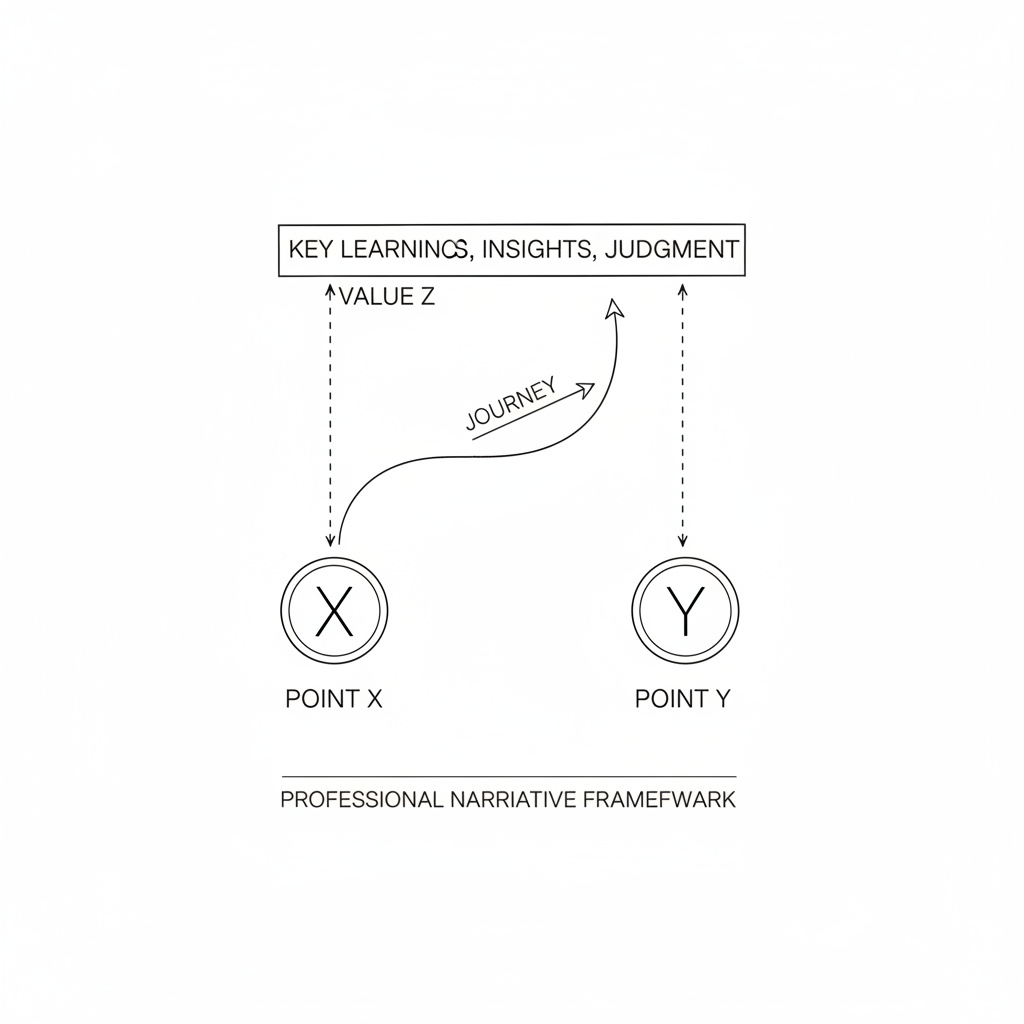
This wasn’t about inventing a story. It was about extracting the story that already existed in my experience.
Where I Am Now
My LinkedIn profile finally reflects who I actually am professionally, not just where I work. When people read it, they understand my perspective and approach before we ever meet. The language is mine, it sounds like how I think and talk about work.
More importantly, I can now articulate my professional identity in any context. Job interviews, networking conversations, project proposals, I have a coherent narrative that connects my past experience to my future direction. The profile has become a tool for recognition rather than just description. Smart peers can see themselves in my trajectory. Potential collaborators understand what I bring to problems. I’m no longer professionally invisible.
What This Means for You
If you’re stuck in the same chicken-and-egg cycle, start with the X-Y-Z structure. Don’t try to write your profile first, identify your narrative first.
Point X is easier than you think. Look at the last six months of your work. What types of decisions do you make repeatedly? What problems do people bring to you? That’s your current professional identity, the role you actually play, not just the title you hold.
Point Y emerges from Point X. If you’re good at solving certain types of problems now, what’s the next level of those problems? What would it look like to have more scope, more complexity, more impact in that same domain?
Value Z is what you’ve learned that you could teach someone else. Not everything, just the insights that feel most hard-won or counterintuitive.
This approach works because it extracts your story from your actual experience rather than trying to invent one. The narrative becomes defensible because it’s grounded in what you’ve actually done and genuinely learned.
Your expertise is already there. The question is whether you can translate it into language that makes sense to people who don’t work inside your current context. That translation, from implicit value to explicit signal, is how you stop being defined by your job title and start being recognized for your professional judgment.