

People don’t decide by spreadsheets alone. Emotion, story, identity, and perception set the first impression; logic follows to justify it. If you want your expertise to register with the right people, design your public signal for how decisions actually happen.
I used to open interviews with meticulous dashboards. The room nodded. Then they picked the person who told the sharper story. That wasn’t unfair, it was human. Once I accepted that, my work stopped being a quiet secret and started reading as signal.
Here’s the thesis: if emotion, story, identity, and perception drive decisions, then your career artifacts must show judgment in a way a smart peer instantly recognizes.
How Decisions Actually Happen
A quick lineage helps. From Le Bon to Berne to Cialdini to Machiavelli, the throughline is simple: we move first by feeling, then tidy with logic. Emotion beats logic. Narrative beats facts. Identity beats truth. Perception beats reality.
In senior hiring, “Would I trust this person with my mess?” beats “Do they tick every box?” Logic still matters, but mainly to avoid obvious risk once trust feels plausible. If you’re a high-competence professional with a weak public signal, that gap isn’t about your depth; it’s about what others can perceive at a glance.
“Humans are not primarily rational” means choices are initiated by feeling, narrative, and identity. Facts and logic arrive later to defend or filter that choice.
Example: Two candidates list identical outcomes. One adds a two-sentence scene, “Inherited a failing vendor switch two weeks before launch; kept the date by changing scope and sequencing risk.” The story makes judgment legible; the facts confirm it.
Making Value Visible
You probably have the substance already. The problem is that it’s implicit, trapped in muscle memory and scattered wins. Others can’t see the pattern you live inside.
A data lead had six roles across fintech. We recast his profile around a single throughline: “I reduce time-to-signal in messy data environments.” Recruiters stopped reading him as a generalist and started seeing a category, then the facts clicked.
If your narrative is clear, peers can map you quickly. If not, they project their own script onto you, and it’s usually wrong. People need a reason to feel safe with you before they need a reason to be impressed by you.
Building for Human Decision-Making
Here’s how to build for that without hype. Start with category plus mechanism plus outcome. Category: what lane you occupy. Mechanism: how you reliably create movement. Outcome: the specific change others can expect.
Thread identity cues that match your target peer group. Not slogans, signals. The tools you choose, the tradeoffs you mention, the constraints you respect. Let facts serve the story. Put the metric next to the judgment call that produced it. “Cut cycle time in half” means more when paired with “by removing two approval gates and adding an automated guardrail.”
We like to believe merit rules because it feels just. But justice in practice is often recognition plus proof. Recognition arrives via story; proof arrives via specifics.
Grounding It With Cases
I worked with a founder who led with tech stack and patents. Smart, rigorous, overlooked. We reframed him as “the person enterprises call when prototypes must survive procurement.” Same facts, new door. Within two weeks, a partner intro landed because someone finally knew where to place him.
An ops lead in healthcare moved from “oversaw scheduling” to “stopped agency spend bleeding by redesigning weekend coverage and union assignments.” The phrase “under constraints” signaled judgment; the compliance note signaled credibility. A security manager shifted from “managed incidents” to “reduced breach window from detection to containment by rehearsing handoffs quarterly.” One number, one practice, one outcome. Clean.
The lesson: you’re converting latent professional value into explicit authority signals. Not inflating. Translating.
Creating Human-Fit Signals
Moments decide careers. Make those moments easy for your reader. Craft one-sentence spine: “I [category] who [mechanism] to deliver [outcome].” That’s your header everywhere. Keep it human, not slogan.
Publish three proof-backed claims. Each includes a scene, a constraint, and a line-of-sight outcome. Map your expertise around problems you solve repeatedly, decisions you make under pressure, and patterns you refuse to break.
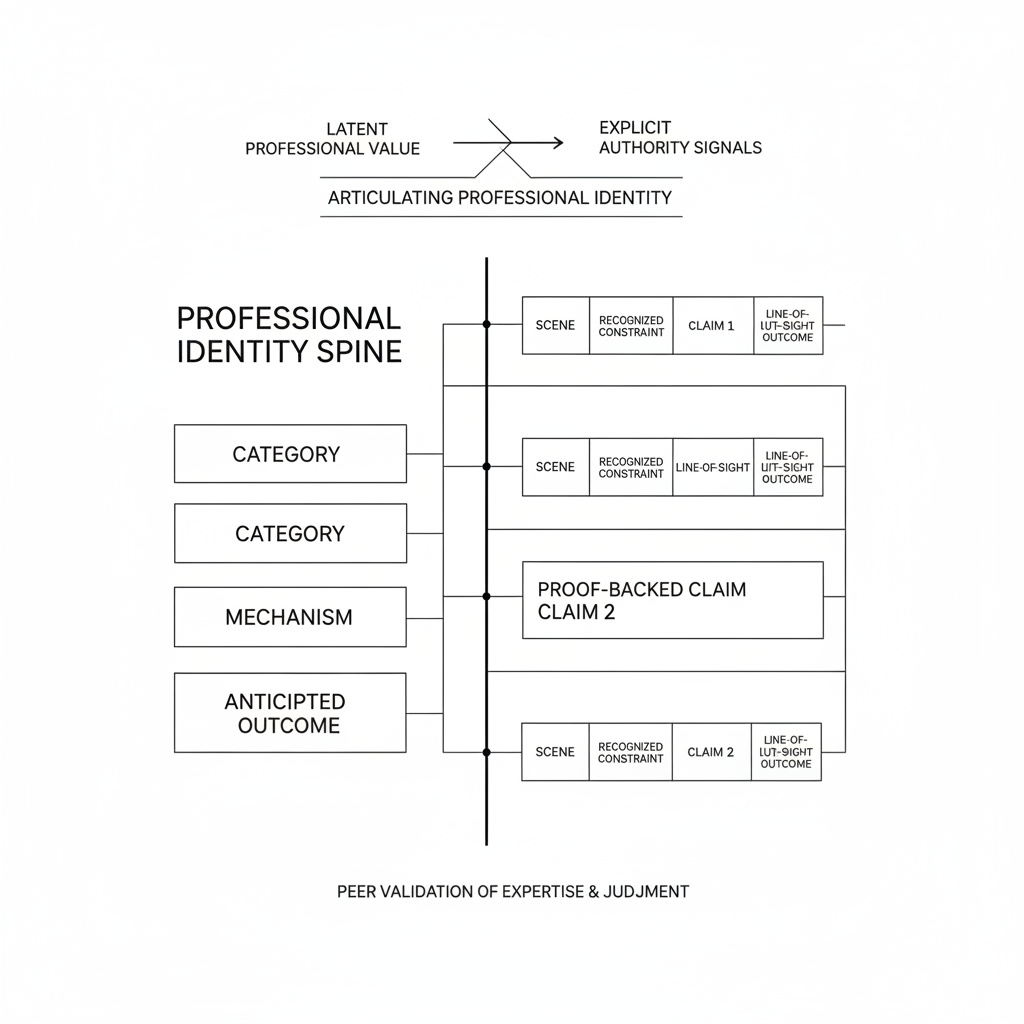
Translate for LinkedIn without performing. Treat LinkedIn as an authority surface: headline equals your spine; About equals three short scenes; Experience equals outcomes anchored to constraints, not task lists. Thread identity carefully by mentioning standards you uphold, environments you thrive in, and tradeoffs you navigate. It reads as fit.
Respect ATS without sounding templated. Mirror the role’s language for must-haves, but tie each keyword to a concrete scene. That’s ATS alignment without keyword stuffing.
Testing for Defensibility
Anyone can write a shiny paragraph. Few can defend it in a peer conversation. Run this quality test: Could a skeptical peer repeat your category plus mechanism plus outcome in one breath? If not, it’s unclear. Does every confident claim sit on a scene or decision? If not, it’s fluff. Would you stake reputation on each example? If not, cut it. Do your signals show judgment under constraints, not just results? If not, add the constraint.
Emotion sets the stage, narrative carries the meaning, identity grants permission, perception governs access. Logic keeps you honest. Design for how people behave, not how they say they behave, and your work will start reading as the peer-level signal it already deserves to be.