
Reality looks chaotic up close because we stare at incidents. Step back and you’ll notice a quiet order beneath them, rules, incentives, and relationships that shape what happens next. Across physics, power, and psychology, that order is what sets the range of outcomes.
Events are signals of an unseen design, laws, incentives, and cues, not standalone surprises. If you act at the event level, problems recur; act at the structure level, patterns change. The key is training your eye to map incentives, constraints, and information flow before you intervene.
See the blueprint beneath events
A project misses its deadline three quarters in a row. You add more standups and work later. The date slips again. The visible story says “people didn’t push.” The real story: the release train, approval path, and reward structure made “on time” irrational.
We gravitate to the urgent because it’s concrete. But urgency is often just the fog on a cold morning, evidence of something colder shaping the air.
Name the cost of chasing noise
I’ve burned months “optimizing” the wrong thing. Once, I kept rewriting a brief after every executive comment. It felt responsive. In reality, the decision rights were split, so edits were a proxy battle. My rework wasn’t diligence; it was a tax paid to unclear ownership.
Costs pile up when you treat symptoms. Time gets eaten by rework instead of root changes. Good people get labeled “underperformers” for behaving rationally under bad rules. You look tactical because your fixes don’t stick.
How structure governs different domains
A short tour builds the instinct without overclaiming. In physics, bodies “choose” paths set by fields and geometry. You don’t negotiate with gravity; you design around it. The lesson: some constraints are non-negotiable. Respect them early.
In society, outcomes cluster around institutions and incentives. Sales teams discount when comp skews new deals over renewals. You don’t fix that with pep talks; you tune the plan. In behavior, habits run on triggers and scripts. If email opens your day, meetings will fill it. Change the first cue, and the day adopts a different shape.
Most professionals have depth that never becomes signal. The work is to convert implicit judgment and decision patterns into coherent positioning and public artifacts, without self-promotion theater.
See the underlying structures at work
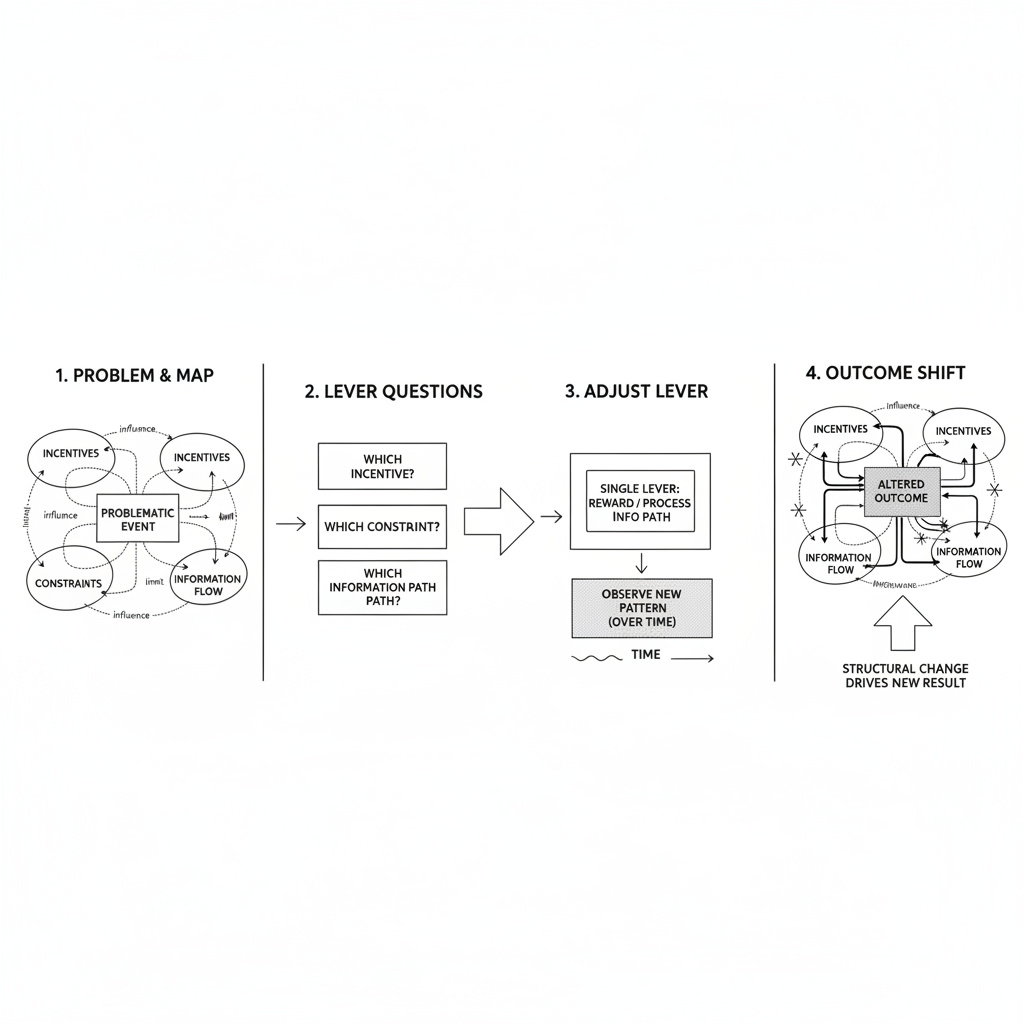
Mechanism, not mystique. Three levers describe most patterns you’ll face. Incentives: What gets rewarded, avoided, or counted? People follow the scorecard, spoken or unspoken. Constraints: What’s fixed, scarce, or gated? Time windows, compliance steps, approval chains. Information flow: Who knows what, when? Latency and asymmetry create bottlenecks and politics.
If you trace an outcome backward through these three, you’ll usually find the blueprint that produced it. When you act, act on the lever that created the shape, don’t sand the edge and call it solved.
Proof in plain sight
Two quick slices you can recognize tomorrow. A customer success leader noticed “hand-offs” spiked at quarter end. Reps weren’t lazy; the comp calendar pushed new logos. She adjusted timing and targets; the spike flattened the next quarter because the pattern, not the people, changed.
A designer kept losing mornings to chat. They moved Slack off the dock and scheduled one 15-minute check at 11:45. Same projects, same team, different mornings. The initial cue shifted; the day followed.
I was asked to “speed up” a weekly status call that always ran long. We didn’t shorten updates. We renamed the meeting “Decision Review, ” moved updates to a pre-read, and put the first 10 minutes on unresolved choices with owners assigned. The call finished early because attention had a different track. No heroics, just redesigned flow.
None of this denies luck. Chance matters. But luck gets channeled by the design it meets, like rain guided by the terrain.
Work the structure, not the event
When you feel the urge to fix what’s visible, pause and run a quick scan. This simple approach helps you intervene at the right level:
- Map in five minutes: Write the event at the top. List incentives touching it (comp, calendar, recognition). Mark constraints (legal, capacity, sequence gates). Sketch information paths (who learns what, how fast).
- Test your read with three questions: If I changed one reward, what behavior would flip first? Which constraint, if relaxed, would make the problem dissolve? Where is the longest information delay, and who pays for it?
- Intervene at one lever: Shift timing or the scorecard wording for a single team. Reorder steps or pre-clear a recurring gate. Create a pre-read, a decision log, or a 10-minute owner sync.
- Watch the pattern, not the applause: Give it two cycles. Did the shape change? If not, you likely adjusted the wrong lever.
Close the loop with clarity
The throughline is simple: events are footprints. The track that made them is the design underneath, laws in physics, incentives in power, cues in behavior. When you see the track, you stop taking outcomes personally and start changing what actually governs them.
Converting latent professional value into explicit authority signals starts here. Show, in your decisions and artifacts, that you act on the blueprint, not the noise. Over time, peers read that as maturity and trust you with harder problems.