

Power doesn’t flow to the loudest voice in the room, it flows through the rails someone else built. While others chase immediate influence through direct command, the architects of durable power design the environment itself.
Power flows through design
In every room, someone talks the loudest. But the person who set the rules directs the music. Seen in Machiavelli, Quigley, Popper: power flows through what structures allow, not who shouts.
Control incentives and you shape behavior. Control narrative and you shape perception. Control institutions and you shape outcomes. Control information and you shape history.
Systemic control is the practice of shaping results by designing the surrounding environment, its incentives, storylines, formal channels, and information flow, so that desired behaviors become the easiest path.
This approach trades direct command for durable influence, because the structure keeps working when you’re not in the room.
Name the lens
I’ve watched teams swarm around a charismatic lead, and stall the moment that person left. Then I saw a dull-seeming process quietly pull a group forward for years. The difference wasn’t will. It was scaffolding.
The core lens: manage the conditions, not the personalities. Direct orders move today’s task; design choices move tomorrow’s default. You decide which track you’re laying. This is the shift from firefighter to architect.
Most professionals carry depth that never becomes signal. They possess implicit expertise and refined decision patterns but struggle to translate these into coherent public artifacts without falling into self-promotion theater.
Design the stage, not actors
One urgent fix feels powerful. Three in a row feels indispensable. Ten in a row means you built a dependency. And dependencies are the enemy of scale.
Incentives nudge behavior, people align to what’s rewarded, not what’s requested. Narrative frames perception by defining what “good” looks like before performance happens. Institutions channel authority through formal gates and rituals that decide what gets resourced. Information sets memory, as what’s measured and archived becomes “history.”
The trade-offs are clear: direct control delivers speed but decays fast, while architecture requires patience but compounds. If you want impact that outlasts you, build rails. If you need a fire out by noon, command the hose, then return to rails.
For your own career, the same logic applies. Your public signal is the environment around your work. Treat it like infrastructure, not a one-off post. Start by clarifying a defensible narrative and one authority artifact that shows judgment under constraints.
Practice systemic control daily
A small design choice, repeated, becomes culture. Here’s how the four levers work in practice without theater.
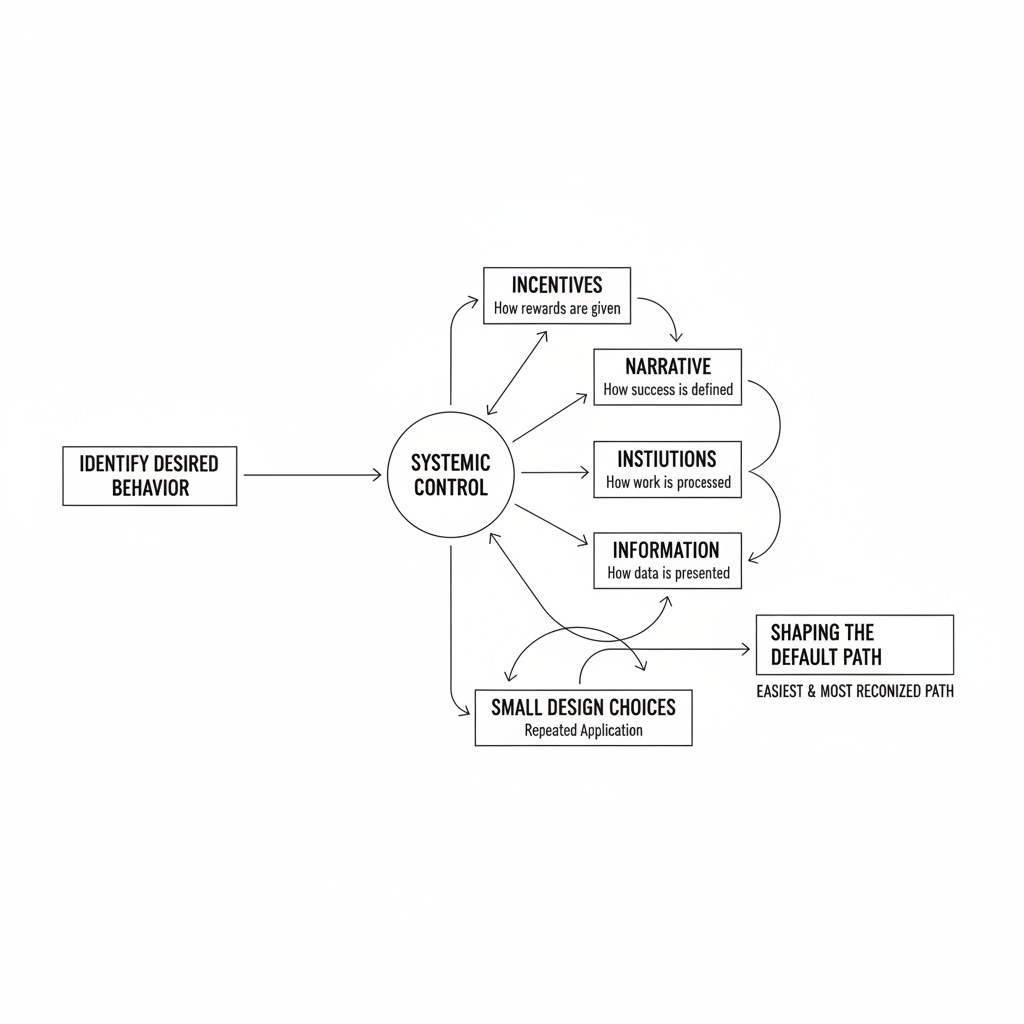
Set a clean incentive by moving from “close more” to “close what the process predicts.” Tie recognition to forecast accuracy and deal quality, not volume. Behavior adjusts because the scoreboard changed. Keep the scoreboard public to strengthen the signal.
Stabilize the narrative by replacing “heroic sprints” with “predictable delivery.” Name the standard in a one-page brief everyone can quote. When the story is stable, perception settles, making coherent positioning possible.
Formalize one institution through a lightweight gate: no project enters build without a problem statement, constraints, and expected outcome on one page. This isn’t bureaucracy; it’s a clarity ritual that sets outcomes before effort and yields proof-backed claims later.
Govern information flow by deciding what gets surfaced weekly and what is archived. If you spotlight error learning and hide blame, history becomes a library, not a courtroom. That’s how a defensible narrative forms.
Control isn’t domination; it’s curation. You’re choosing which paths are well-lit. People still walk where they want. Most choose the lit path.
See it in practice
I prefer proof over slogans. Three quick slices show how this works.
A director ended late projects by changing the meeting slate. She added a standing 15-minute “de-scope first” segment before estimates. No threat, no drama. In two cycles, teams shipped on time because the ritual normalized trading scope for predictability.
A VP swapped the monthly leaderboard for a pipeline quality review. Deals missing a verified problem statement weren’t celebrated. Reps learned that clarity beat bravado. Forecast misses dropped because history recorded substance, not noise.
An engineering manager replaced generic interviews with a constraint brief and a pair-debug session. Candidates who thrived under ambiguity surfaced; the ones who performed only in polished rehearsals didn’t. The institution produced better outcomes than more interviews ever did.
Early in my advisory work, I used to rewrite teams’ plans line by line. It flattered me and exhausted them. Once I focused on three levers, who gets to greenlight, what counts as “done, ” and which metrics are read aloud, clients improved without me present. I became optional. That was the point.
Start small, design once
You don’t need a grand overhaul. Pick one setting you control this week and set a new default.
Pick the lever first. If chaos rules, start with institutions by creating a single-page entry gate for work. If apathy reigns, start with incentives by making the right thing the easy thing to win.
Write the story in 6–8 sentences that define what “good” looks like. Share it in the channel your team actually reads. Repetition beats novelty.
Freeze a ritual by tying your story to a weekly moment, a review, a demo, a retro. The ritual is the skeleton key; it carries the rule even when you’re away.
Manage the record by deciding what is measured and how it’s displayed. If the metric invites theater, change it. History is an editorial choice.
For your career, publish one authority artifact that makes your judgment visible, a teardown, a decision memo, or a brief before/after of a process you redesigned. That’s how you convert latent professional value into explicit authority signals without performance.
Test for durability
Before you call it progress, run a simple check. If you left for a month, would the behavior persist? If yes, you changed an environment. If not, you ran a campaign.
Can a smart peer explain your approach in your words? If yes, you’ve built coherence; if no, your narrative is still private.
Does the structure reward the right trade-offs when pressure hits? If yes, the rails are aligned; if no, you’ve got a pretty poster over the same old track.
The levers can be used ethically or not. Transparency matters. If people discover the rails are rigged, trust collapses and resistance organizes fast. Design as if you’ll have to explain it later, because you will.