

Most professionals assume the work should speak for itself. It doesn’t. Recruiters are paid to avoid mistakes, not to rescue overlooked talent, and the asymmetry is brutal: one reason to doubt outweighs ten reasons to believe.
Inboxes are full, alternatives are plenty, and hesitation is a quiet “no.” The job isn’t to impress, it’s to remove doubt.
Risk surface, in plain terms: it’s the sum of small signals in your profile that raise the perceived cost of contacting you, time to decode, risk to reputation, and effort to explain to a hiring manager. Each tiny friction compounds into hesitation. In a high-volume search, hesitation is rejection without feedback.
Recruiters optimize for avoiding regret, not chasing potential; doubt compounds faster than promise. Your risk surface is built from minor signals, gaps, inflated titles, contradictions, that make contact feel expensive. The solution isn’t adding more achievements; it’s removing the single riskiest visible signal first.
Make your risk surface visible
You’ve likely felt this from the other side: a vendor pitch with small red flags that make you pass without a reply. Profiles work the same way. Risk surface is the total of small cues that raise the cost of engaging you. Time pressure means every uncertainty demands interpretation. Reputation risk forces recruiters to defend their choices to hiring managers. When many profiles appear “close enough, ” any friction tilts the decision to someone else.
A micro-example illustrates the dynamic: a two-year gap with no context forces a guess. Guessing invites risk. If another candidate requires no guessing, the decision is simple. My stance is simple: I study risk-avoidance behavior, not résumé cosmetics. Your experience can be strong and still get filtered out by how much work a profile looks like.
Spot the five micro-risks
If you feel defensive reading these, good, that’s the signal they create in the reader. Title inflation without scope creates immediate doubt. When the title reads “Head of X” but the bullets show individual contributor tasks, it suggests overreach. Recruiters worry they’ll surface someone whose seniority won’t hold up in conversation. That risk is reputational and immediate, so they choose a profile that fits the claimed level.
Inconsistent role naming across jobs forces translation work. “Product Manager” at one company, “Program Lead” doing the same work at the next, then “Project Consultant” for similar scope creates confusion. The reader wonders if titles were manipulated or if the scope actually varied in ways that matter. They move on to a cleaner arc.
Date gaps with no narrative marker create ambiguity. Gaps happen, but silence around them begets stories, none flattering. A recruiter expects to justify you in a sentence; a gap without a marker means they’d need to investigate and explain. Most simply won’t; they pick a profile that explains itself.
Over-polished, generic language obscures proof. When every line reads like corporate boilerplate, “dynamic leader, ” “results-oriented, ” “strategic visionary”, the reader can’t find substance. Generic phrasing looks like a sheen applied to thin content. The risk isn’t just fluff; it’s misalignment with the actual role.
Proof artifacts that contradict claims are hard stops. You claim “led go-to-market, ” but the portfolio links show support tasks. Or you cite “managed a team, ” yet peers endorse only individual work. The reader imagines having to justify those mismatches later and chooses a profile without that burden.
Why “it’s probably fine” backfires
You might be thinking: everyone has small quirks; a human would ask; they should look closer. Here’s why they don’t, and won’t. “Everyone has this” is true, but not everyone stacks the same set. Risk is cumulative. If yours creates more questions per minute than a near-peer, you lose to the easier option.
“A human would ask” assumes time most don’t have. Contact is a bet, and the first bet they need to win is with their own calendar. “They should look closer” misses the incentive structure. The goal is to avoid embarrassment. When two profiles are both plausible, the tiebreaker is the one that requires the fewest explanations to a manager.
A recruiting lead told me they had two finalists with similar outcomes. One had a small title inconsistency and a gap with no note. They chose the other. The reason: “I didn’t want to explain two things when I could explain none.” That’s the job.
We like to imagine the process is a merit tournament. It isn’t. It’s a series of small, conservative choices made under pressure. Presentation isn’t vanity; it’s risk management in a noisy market. If that feels frustrating, notice the cost of insisting otherwise.
Use the one‑risk rule
When you’re tempted to add another bullet or new certificate, stop. Subtract the single riskiest visible signal first. Look for the doubt that would force the most explaining if someone had to defend you sight unseen. Remove or neutralize that one thing before touching anything else.
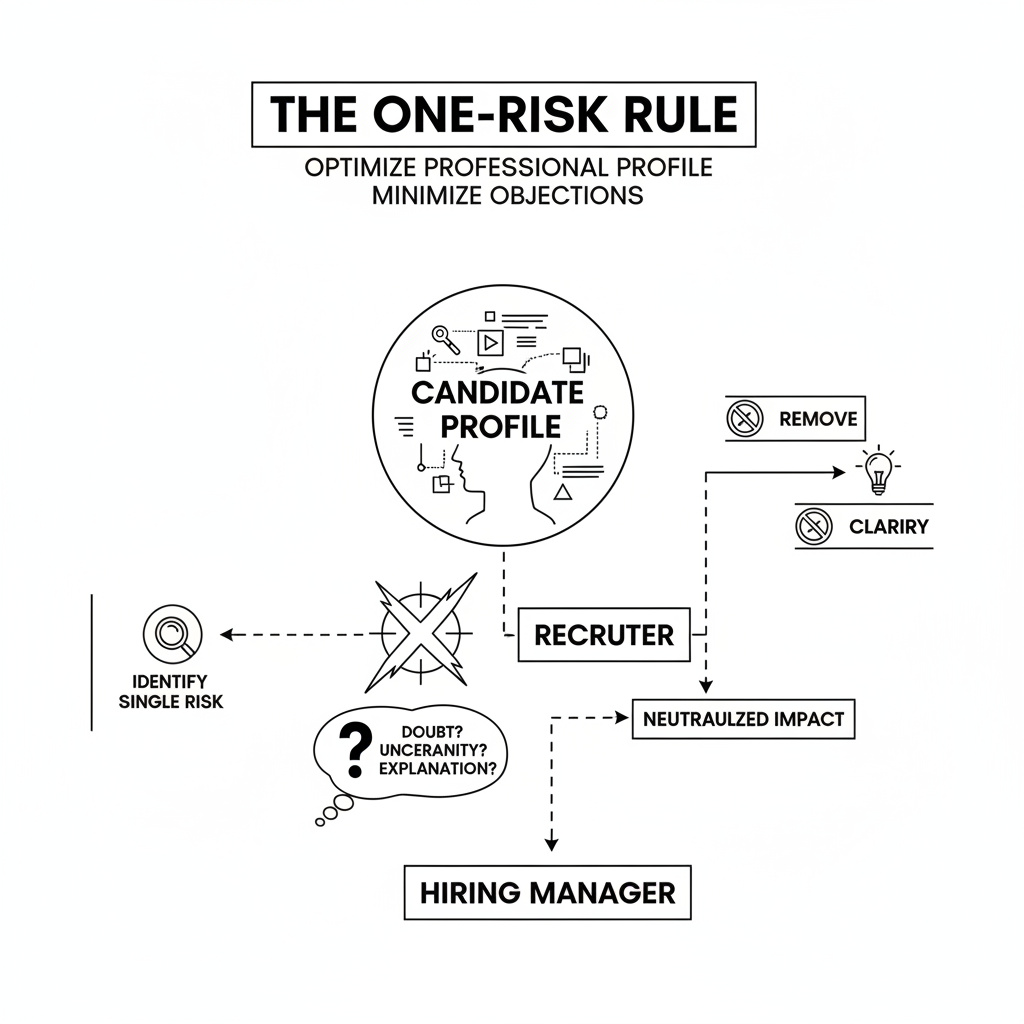
Subtraction beats addition in practice. A candidate with strong outcomes kept a “Director” title from a startup where the scope was actually team-of-one. They replaced the title with the company’s internal level and left the scope to speak for itself. Inbound improved, not because new achievements appeared, but because the biggest doubt was gone.
Another micro-example: a three-year block marked with overlapping freelance and full-time dates looked messy. Removing the overlap and adding a simple clarifier (“part-time consulting alongside full-time role”) made the profile legible. No new content. Less confusion.
Run the justification test
End where recruiters begin: would you be easy to defend if someone had to stick their name on you after a 30-second scan? Ask yourself: “If I had to justify contacting you to a hiring manager, what would I need to explain away?” That’s your risk surface. Remove the biggest piece first.