

Most professionals have depth that never becomes signal. A one page personal brand turns implicit value into explicit authority, and does it in under a minute.
One page beats a folder of links. In under a minute, a sharp peer should know who you are, where you’re strongest, and why they should care. That’s the promise, and the bar, of a one page personal brand.
A one-page personal brand is a single, owned webpage that compresses your professional identity into a clear, credible signal. It states who you are, the problem you solve, how you do it, and proof, without fluff. Everything else links out, making this page the canonical source.
Expose the hidden gap
A colleague once told me, “I thought you were a generalist until I read your one pager.” That’s the gap: what you can do vs. what the internet thinks you do.
Most digital footprints are fragmented. A resume records employment history, not judgment under constraints. LinkedIn is useful as an authority surface, yet it’s shaped by the platform’s fields and feed. Side sites like Medium, Behance, GitHub, and Notion each highlight a narrow slice. The result is noise: people have to assemble your story themselves, and they won’t.
Consider a PM with a polished LinkedIn, a Medium post from last year, and a Notion portfolio. Each is fine alone, but together they read as “miscellaneous.” A single authority page with a crisp headline (“Product leader who ships durable growth through constraint‑driven bets”) and three proof slices reframes the whole picture. If your value is implicit, others will anchor on titles, not outcomes.
Stop scattering signal
A busy buyer, hiring manager, or collaborator gives you about 30 seconds before they decide whether to dig in or move on. Every extra click is friction; every disconnected blurb halves clarity.
Resumes capture history, not judgment. They rarely show how you think, how you decide, or how you reduce risk. Social bios compress to slogans. Portfolios often over‑index on artifacts over reasoning.
Authority is partly the ability to compress without distortion. When you remove filler, you’re left with essentials, clarity, coherence, and proof.
Try this triage: could a smart peer answer these in one scroll? Category: What are you in the market as? Mechanism: How do you reliably create results? Outcome: What proof backs that claim?
A data scientist shifting to healthcare AI reframes from “Senior DS” to “Applied ML for clinical throughput, reduce patient wait times with workflow‑aware models, ” then adds a concise case showing a before/after decision path. Now the signal is coherent, not generic.
Compress to authority
Picture a clean page with a single throughline. It opens with a precise headline (category), follows with a short paragraph that names how you operate (mechanism), and lands on three proof points (outcomes). Everything else, LinkedIn, GitHub, long case studies, lives one click away.
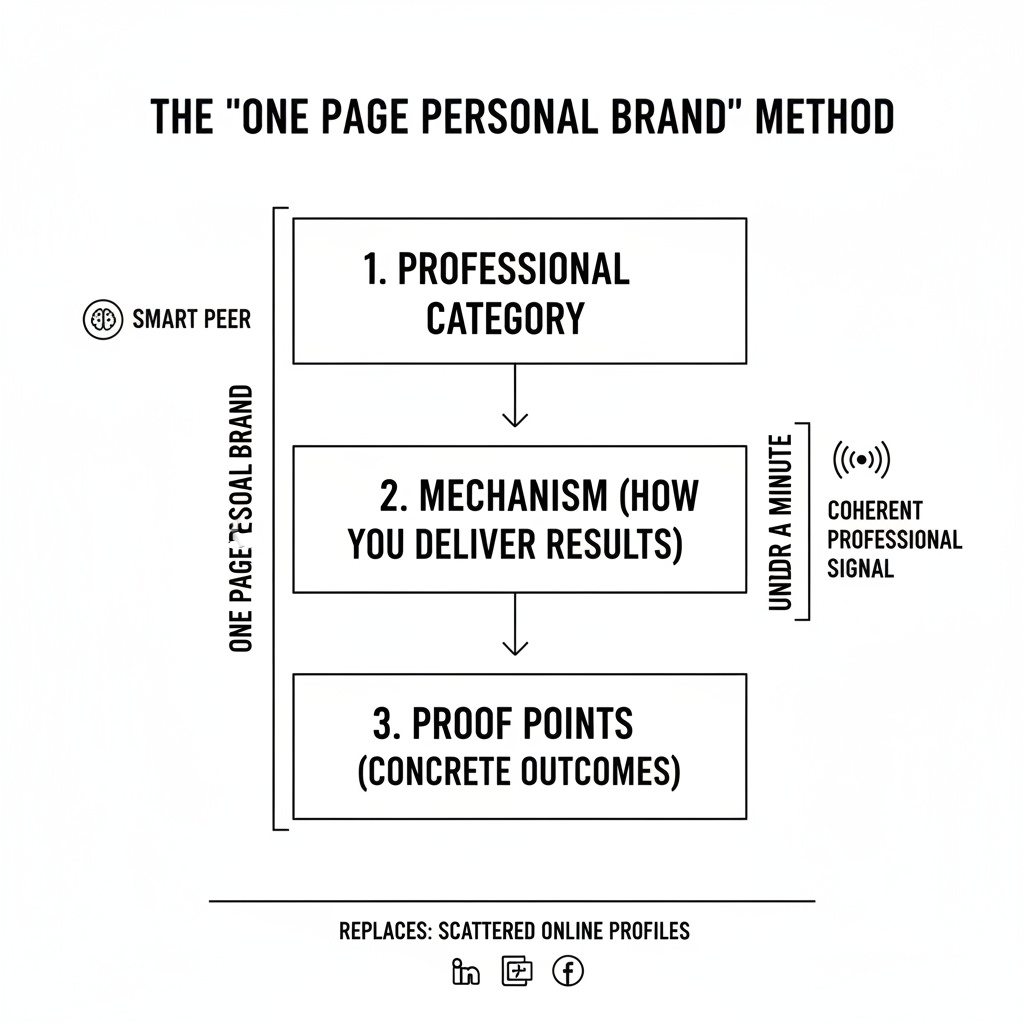
What sits on the page: An authority headline that states who you are for whom, in plain language. Aim for meaning over optics. Follow with 90–120 words on how you work, your decision patterns and judgment in constraints. Name the tradeoffs you handle. Add proof that signals maturity: a short case, a quote with context, or a number with the story behind it. Keep claims defensible. Include an expertise map of 5–7 repeatable competencies grouped by theme, not a laundry list. Make contact easy with a single next step.
A principal designer swaps a glossy grid for one tight case: “Cut onboarding drop‑off by redesigning consent + copy. Constraint: legal language. Move: progressive disclosure with plain-English variants. Result: fewer support tickets; legal sign‑off preserved.” One case like this beats 12 screenshots.
That compression isn’t cosmetic; it’s a signal that you can judge what matters under limited attention. If your page can do that, people trust you faster.
Consider the tradeoffs
As a consultant, I used to send three links depending on who asked. People skimmed and replied, “Looks great, ” then went quiet. The week I shipped a single, tight page, I started getting specific replies: “I saw how you structure bets, let’s talk about our pricing project.” Same you, clearer signal.
Common objections surface quickly. “A single page will get stale.” True if you never revisit it. Add a quarterly review to keep the proof fresh. The page is a hub; it evolves with you. “LinkedIn already has reach.” Keep using it. Treat your page as the canonical source and pin it. The network effect stays; the narrative control shifts to you. “For my field, GitHub or Behance matters more.” Great, link them. The point isn’t to replace depth platforms; it’s to frame them. “I’m not a writer.” You don’t need flourish. You need precision. Write the page out loud, then cut to the verbs and nouns that carry meaning.
Quality gate: Ask a peer to read your page for 30 seconds. If they can’t restate your category, mechanism, and one proof, it’s not ready.
Build a one page personal brand
A short walk, done well, beats a marathon you never finish. Ship this in a focused hour, then refine next week.
Start by setting the spine. Write one line for category (“Fractional CFO for B2B SaaS”), one for mechanism (“Design cash discipline that survives stress”), and one for outcome (“Help teams fund growth without starving core ops”). Keep it plain. Draft the authority headline by combining the three into one sentence up top. Avoid buzzwords; prefer concrete nouns and strong verbs.
Add 1–3 proof slices that show judgment under constraints, not just happy outcomes. Name the constraint, the move, and the result. Map your expertise by listing the work you do repeatedly. Group into themes and cap the list. This prevents keyword stuffing while aligning with ATS terms naturally.
Link out, don’t dump. Point to GitHub, Behance, or long write‑ups for depth. The page stays concise; details live one click away. Make contact easy with one clear way to reach you. Skip the clutter. Run the resonance test by sharing with a smart peer. If they recognize you as you want to be known, you’re close. If not, tighten the language.
To translate for LinkedIn without performing, lift your headline and 90‑word “how I work” paragraph into your About section. Pin your one‑page site at the top. Now the platform boosts reach while your page holds the narrative. For ATS alignment without sounding like a template, place role‑specific terms inside your expertise map and case summaries where they actually apply. You’re matching language through context, not stuffing a keyword block.
Let one page carry the weight
Clarity compounds. A central identity node makes every introduction cleaner, every profile purposeful, and every opportunity easier to qualify. The artifact is simple; the thinking behind it is not. Do that thinking once, in one place, and let the page do the heavy lifting.