

Most resumes read like museum labels, accurate, tidy, and silent about the thing that actually drives trust: how you make decisions when it counts.
If you’ve felt overqualified but overlooked, you’re likely fighting with a weak public signal, not a lack of skill. Here’s the thesis in plain terms: convert latent professional value into explicit authority signals. That means making your judgment and repeatable outcomes legible to both people and machines, without turning yourself into a performer.
A static CV is a historical record; a living signal is a structured, discoverable trail of proof that shows how you think, decide, and deliver. Search, AI, and networks index the latter. If you want opportunity to find you, build a legible signal instead of only polishing a PDF.
The blind spot most professionals miss
I used to send immaculate PDFs and wait. Calls were sporadic and often off-target. Then I watched less-experienced peers receive sharp, on-fit inbound because their thinking was visible.
The blind spot is simple: your best work lives inside meetings, docs, and instincts, none of which travel on their own. A resume compresses it into nouns. What you need is a light trail of proof that functions as a public signal. One short case that shows how you resolved competing constraints often tells more than three polished bullet points.
Consider a staff engineer who quietly led three gnarly incident recoveries but listed “on-call rotation” and “improved reliability” on their CV. After publishing a concise write-up of one incident, context, options weighed, trade-offs chosen, result, they started fielding targeted ops roles because the right peers finally recognized the shape of their judgment.
Why “personal brand” isn’t performance theater
You might resist the phrase “personal brand” because it sounds like performance. Fair. But you do need to be findable and legible. That’s not theater, it’s translation.
Branding as performance tries to manufacture status; branding as clarity makes your thinking easy to recognize.
The first chases optics; the second organizes evidence. A data leader posted one practical note on how they cut false positives in monitoring by halving noisy rules and adding a human-in-the-loop check for two weeks. No hashtags, no platitudes. It was shared in two private channels and led to three relevant conversations, not virality, just precision.
Show judgment, not just jobs
Resume bullets tell me you “owned, ” “led, ” or “drove.” None of that proves how you decide. Trust forms when I can see how you balance risk, time, and outcomes.
What peers look for is judgment under constraints. Can you reveal the tension you managed, deadline vs scope, quality vs cost, the options you considered, and the rationale behind your choice? A single, specific slice of work that exposes trade-offs carries more weight than a page of titles.
I once helped a founder who’d scaled support from chaos to calm during a product surge. Their CV said “built support function.” We pulled one ticket spike as a case: 48-hour backlog, 3 channels, team of 4. They triaged by impact, wrote a simple escalation rubric, and cut response time while protecting bug triage. Publishing that 400-word account changed who reached out, operators, not generalists, because the thinking was visible.
How modern discovery actually works
A quiet PDF parked in a folder is a billboard in the woods. Today, discovery flows through search, feeds, and referrals that index structure, not just titles.
Machines and networks latch onto clear nouns, repeated patterns, and consistent phrasing. If your language is scattered, you’re hard to route. If your evidence is thin, you’re hard to trust. Treat LinkedIn as authority surface: use it to host a handful of proof-backed notes that show how you operate, not just what you claim.
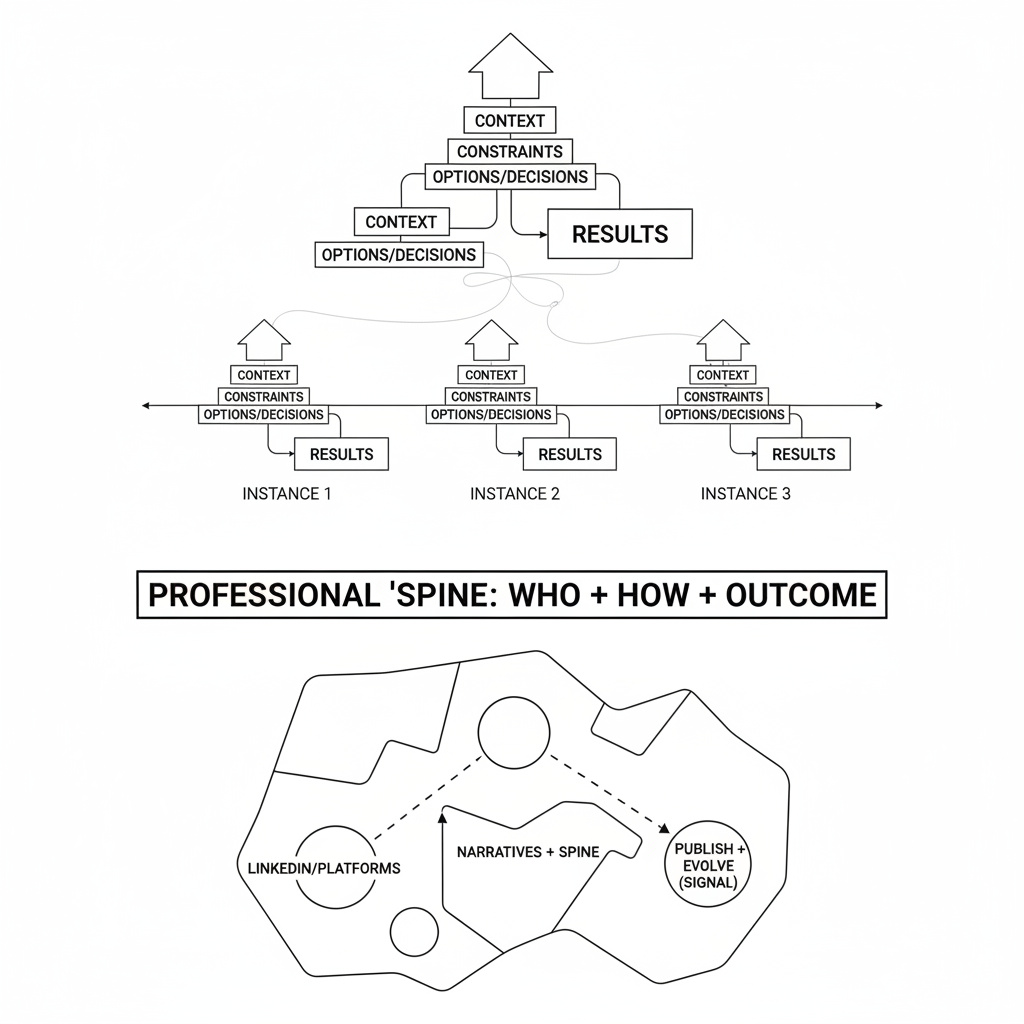
A crisp spine helps here: center on the category you serve, how you solve within it, and the kind of outcomes you repeatedly produce. When those three elements appear consistently across a summary, a few posts, and a project page, you become discoverable for the right reasons.
Work within real constraints
Maybe your field still expects a CV. Maybe you’re busy. Maybe the performance pressure turns you off. All valid constraints that don’t negate the need for signal.
Some industries require a CV, keep it current, just don’t treat it as your only surface. Time is finite, so favor a light cadence over bursts. Two hours every other week can maintain a credible signal without becoming a second job. You don’t need to “perform”, write for one smart peer, show cause-and-effect, skip theatrics.
Recruiters still use filters, so maintain ATS alignment without keyword stuffing. Mirror the phrasing your market uses, but tie each keyword to a line of evidence. If you claim “incident management, ” link to one concise incident note.
The aim is consistency, not volume. You’re building a trail others can follow back to real work.
Convert your resume into discoverable signal
Here’s how to turn static history into something discoverable without becoming a content creator. Start by extracting proof from past work, pick three moments where your judgment changed an outcome. Write 150–300 words each: context, constraint, options, decision, result. These become your authority artifacts.
Next, name your spine clearly. In one sentence, state who you help, how you solve, and what tends to happen after. Keep verbs concrete. For example: “I help B2B teams stabilize flaky pipelines by standardizing test isolation and teaching engineers to debug with logs first.”
Place your proof where it can work. Add the spine to your LinkedIn headline and summary, pin two proof pieces, use consistent phrasing across your website or portfolio. Then maintain a light cadence, aim for three proof pieces in the next 90 days. Spend about two hours every other week to edit or publish one note.
What changes next isn’t just visibility, it’s fit. Colleagues, recruiters, and founders can tell what you’re for and what you’re not. That saves time on both sides and ensures the opportunities that find you actually match what you want to do.
Work that never becomes signal is indistinguishable from work that never happened. Making your decisions legible isn’t self-promotion; it’s professional hygiene. The shift from employment record to capability signal doesn’t require theatrics, just clarity that converts latent professional value into explicit authority signals.